Lecture 03 Object Oriented Design Principles
Joseph Haugh
University of New Mexico
Free Recall
- Get out a sheet of paper or open a text editor
- For 2 minutes write down whatever comes to mind about the last class
- This could be topics you learned
- Questions you had
- Connections you made
A Starting Point
- Simplifying assumptions:
- the program execution is sequential
- the program executes on a single machine
- The program is hierarchically structured in terms of three levels:
- main program
- subordinate objects
- external devices
Relevant Concepts
- Main program
- an active procedure
- controls the execution logic
- invokes methods on subordinate objects
- Subordinate objects
- are objects in the programming sense
- offer public methods to the main program
- do not interact with each other
- have no public fields
Key Relations
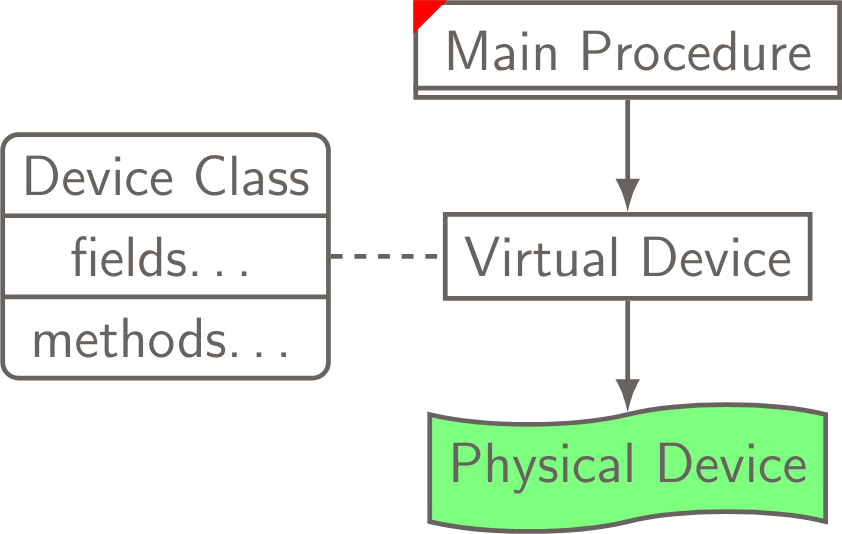
- The relation between the main program and the subordinate objects is a reference relation
- the entity above may invoke services provided by the entity below i.e., the procedure may call methods on the objects below
- The relation between objects and external devices is an encapsulation relation
- an external device is encapsulated by a single object
- access to the external device below is controlled by the object above
Notation
Design Principles
- Separation of Concerns
- Information Hiding
- Data Encapsulation
- Device Encapsulation
- Balanced Levels of Abstraction
- Protection Against Change
1. Separation of Concerns
- The principle of separation of concerns demands that:
- unrelated concerns should be associated with distinct entities in the design
- related concerns should be associated with a relevant entity in the design
- This principle impacts design decisions relating to modularity
- Object-oriented design enables the application of this principle
- Strict application of the principle is not always straightforward
- Changes to requirements may have a major impact on the design
Example: HTML, CSS, and Javascript
- HTML: HyperText Markup Language, used to specify the contents of a webpage
- CSS: Cascading Style Sheets, used to specify the style of a webpage
- Javascript, used to specify the behavior of the webpage
- Each piece has it own separate use and a change in one should* not affect the others
2. Information Hiding
- Also known as encapsulation
- Limit knowledge about design decisions as much as possible.
- fundamental to encapsulation
- Postpone design decisions for as long as possible.
- fundamental to top-down design
- This relates strongly to the scope of program changes… How we can minimize them?
Effective Java: Item 15
- Item 15: Minimize the accessibility of classes and members
- A well designed component hides all its implement details
- Cleanly separates its API from its implementation
- Gives programmers the ability to think about one part of the system at a time
- Allows precise optimization
- Cardinal Rule: Make each class or member as inaccessible as possible
Information Hiding: Example
- Let’s go to IntelliJ for an example
- You can download these files here
3. Data Encapsulation
- Bundling data with methods that operate on this data.
- Decoupled implementation details from operations on the data.
- This simplifies programming.
Illustration: Custom Dictionary
- Consider an object called MyDictionary:
- initially contains an empty set W of words
- at most N words can be stored
- addWord(w) – adds one word to the set W, if there is room for it
- removeWord(w) – removes one word from the set W
- containsWord(w) — returns true iff the word is in the set W
- Simple Implementation: array of strings
Illustration: Custom Dictionary Revisited
- Consider the following change in requirements:
at most N words can be stored- the number of words is very large
- This new implementation requires a tree structure.
4. Device Encapsulation
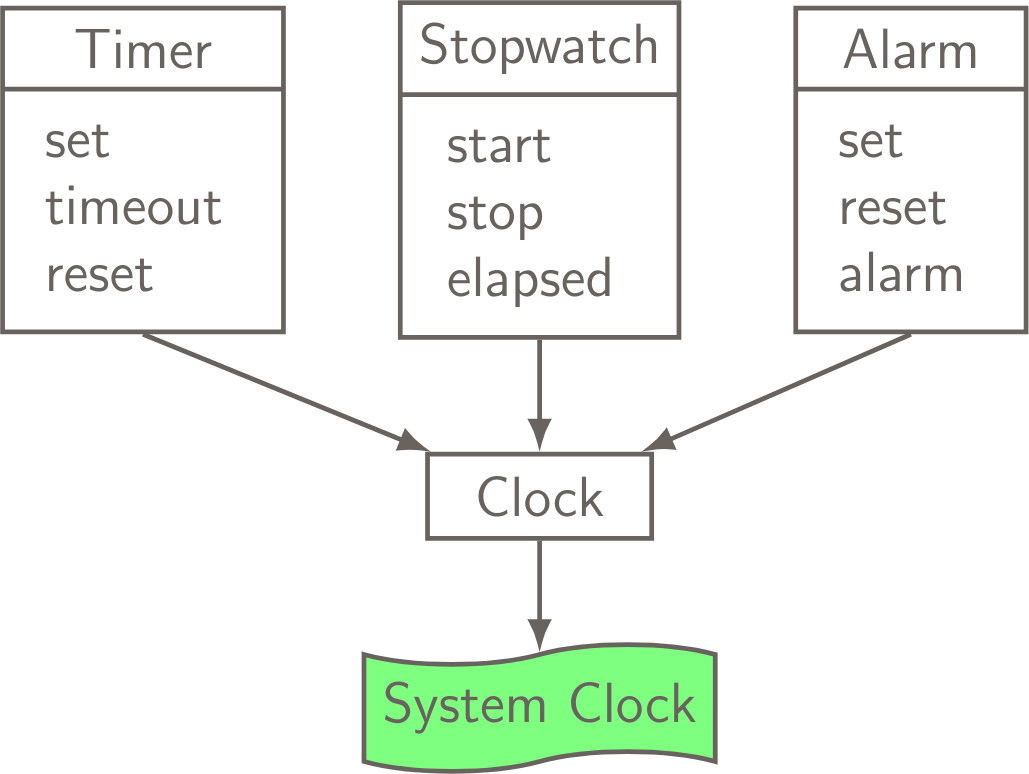
- Devices are a volatile element of most designs.
- Protect the system against device/protocol substitutions:
- micro-controller reassignment of pins
- communication interface (USB connection vs. Ethernet)
- memory mapped I/O
- Layers of encapsulation:
- application-specific virtualization
- virtual device
- device driver
Illustration: Timers
5. Balanced Levels of Abstraction
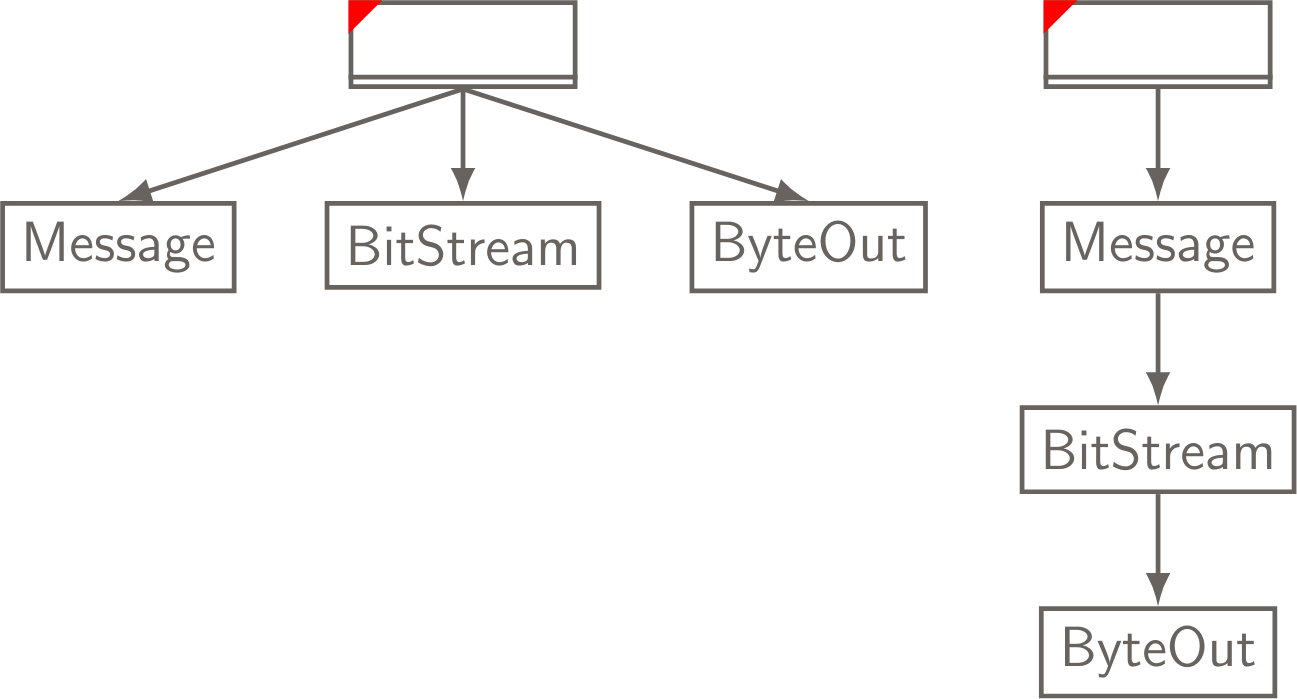
- In a hierarchically designed program or system:
- when moving up in the structure the level of abstraction should increase
- when moving down in the structure the level of abstraction should decrease
- entities at the same level in the structure should exhibit comparable degree of abstraction
Illustration: Message Delivery
6. Protection Against Change
- The fundamental engineering concern of object-oriented design is to protect the design and implementation against impact of potential changes
- modifications to delivered code are expensive
- modifications can introduce errors
- limiting the scope of potential changes reduces cost and mitigates risks
- Any proposed design needs to be analyzed with respect to the impact of changes
- processing logic
- processor changes
- device substitution
- elimination of performance bottle necks