Lecture 04 Architectural Design Patterns

Joseph Haugh

University of New Mexico

Free Recall

  • Get out a sheet of paper or open a text editor
  • For 2 minutes write down whatever comes to mind about the last class
    • This could be topics you learned
    • Questions you had
    • Connections you made

Software Development Revisited

  1. Specification
    • precisely define the problem to be solved
    • validate one’s understanding of the problem
  2. Design
    • outline a solution path
    • plan the implementation
  3. Implementation
    • build the software
    • use the constructs available in the programming language

Implications for this Course

  • Skill development with a focus on design and implementation
  • Specific skills to be acquired:
    • ability to understand and conceptualize a problem
    • ability to lay out a coherent and complete design that solves the problem
    • ability to plan an implementation targeted to a specific programming language
    • ability to deliver fully functioning code incrementally

Is Our Perspective Unique?

  • Specification/Design/Implementation paradigm is not specific to software
    • kitchen
    • landscape
    • electronic device
    • mechanical device
  • In software engineering as well as in other engineering disciplines, the specification/design cycle is applied recursively
    • system
    • subsystem
    • component
    • sub-component

Software Architecture

  • The design of a software system is captured by a Software Architecture Design
    • an abstract description of the system’s structure and behavior
    • not an exact reflection of the code organization
  • The level of abstraction is chosen such that:
    • all critical design decisions are apparent
    • meaningful analysis is feasible
    • implementation plans can be developed
    • all interfaces are precisely defined

Why Bother?

  • No major engineering achievement is possible without design and analysis
    • home building without plans
    • car manufacturing without precise part specifications
    • radiation treatment machine without precise analysis
    • moon shot by trial and error
  • Teamwork demands a common plan of action and coordination

Design Diagram

  • A typical software architecture is specified by a combination of:
    • design diagrams
    • component specifications
    • external interface specifications
  • A design consists of two types of entities:
    • components - code modules relevant to the overall design
    • connectors - suggestive of the interactions among components

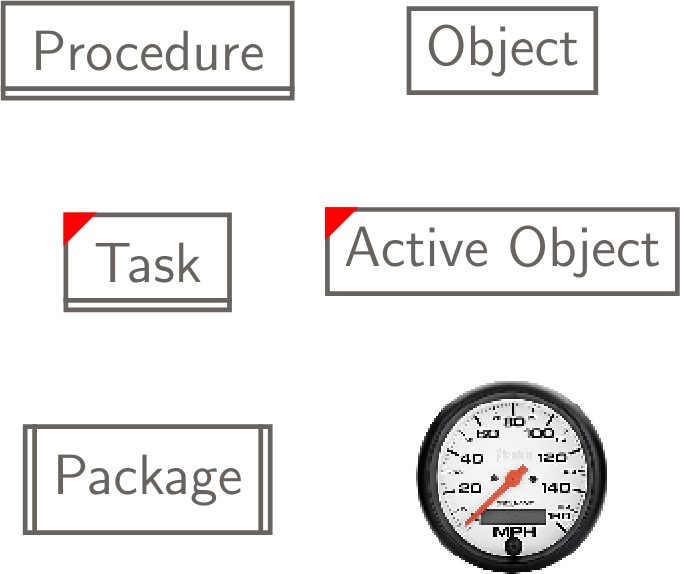
Notation: Components

  • Passive
    • procedure
    • object
  • Active
    • task
    • active object
  • Organizational
    • package
  • External
    • devices and interfaces

Notation: Connectors

  • Architecture diagrams may use a wide range of connector types:
    • standard (widely used in the literature)
    • custom (defined specifically to meet the needs of a particular system)
  • Basic connectors:
    • aggregation - structural abstraction
    • reference - behavioral constraint

Connector: Aggregation

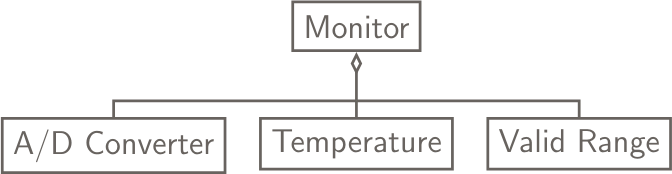
  • The aggregation connector captures structural properties of objects
    • constrains the scope of object definitions
    • constrains the method invocation pattern

Connector: Aggregation Continued

  • Aggregation is a relation between:
    • an object and lower level objects to which it has exclusive access
    • the scope of the subordinate objects is limited to the object above
    • subordinate objects are often instances of some general class
      • may have an independent existence
      • may be used in different settings
  • Aggregation makes object composition possible

Illustration: Aggregation

public class Monitor {
    private Temperature temp;
    private ADConverter converter;
    private ValidRange range;

    public void update() {} // Updates monitor with data from the ADConverter.
    public void setMinValue(Temperature temp) {}
    public void setMaxValue(Temperature temp) {}
    public boolean inRange() {}
    public void clearHistory() {} // Clears list of anomalous readings.
}
Connector: Reference

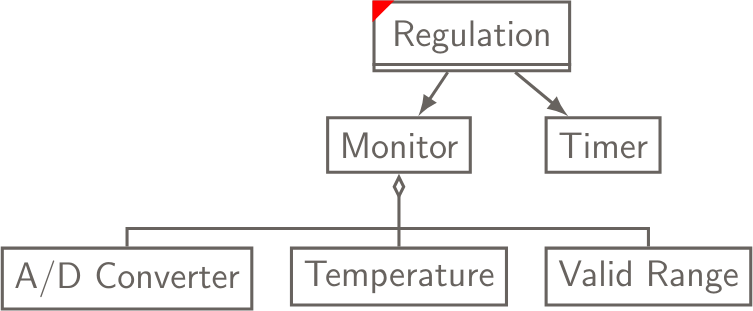
  • The reference connector captures run time object usage pattern
    • constrains the method invocation pattern
  • Reference is a relation between:
    • a procedure and the objects it accesses
    • an object and lower level objects it accesses

Illustration: Reference

public void regulateTemp() {
    long updateInterval = 500;
    timer.setInterval(updateInterval);
    while (!timer.timedOut()) {
        monitor.update();

        if (!monitor.inRange()) {
            // ...
        }
        // sleep(10) ...
    }
}
Effective Java Item 18: Favor composition over inheritance

  • Inheritance is ill advised when used with classes you do not control
  • Instead use composition to add functionality
  • Download example files here

Static vs. Dynamic Systems

  • A system is static in nature if its structure does not evolve at runtime
    • design diagrams are also static in nature – a good match
  • A system whose structure evolves during runtime execution is dynamic
    • new components are created
    • connector patterns change

Static Diagrams for Dynamic Systems

  • The use of static design diagrams is made more difficult when designing a dynamic system
    • capture the most representative structure statically
    • capture one or more representative structures
    • explain the system evolution rules separately

A Static System

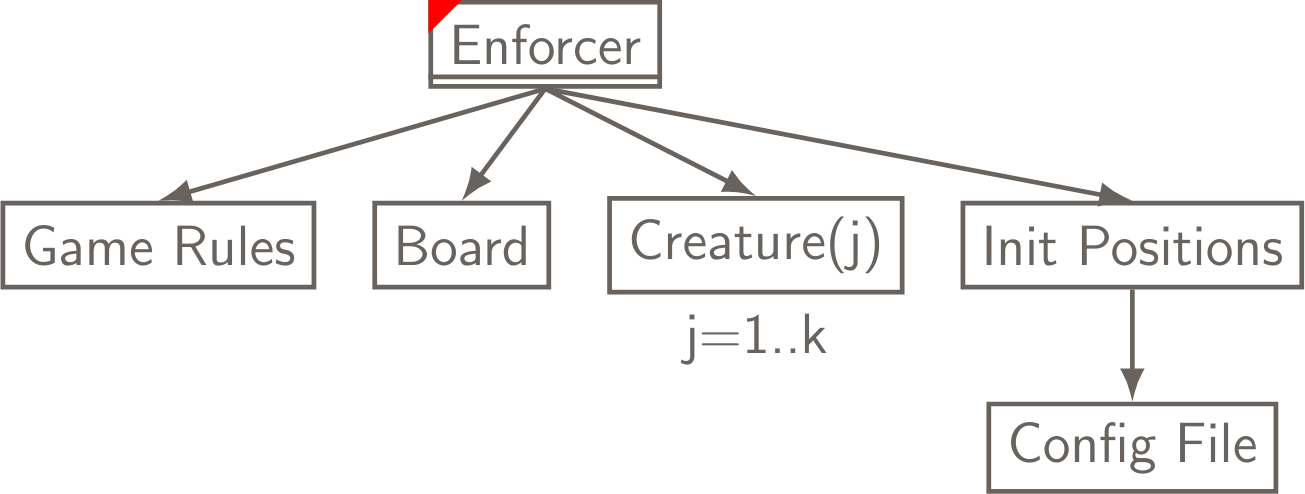
  • Consider a board game called LiveChess:
    • standard chess board
    • pieces are creatures with a mind of their own
    • a fixed set of pieces are used
    • a configuration file defines the initial placement of pieces
    • pieces are given turns to move according to some set of rules
    • each piece selects a move which is executed only if valid

A Static System

A Dynamic System

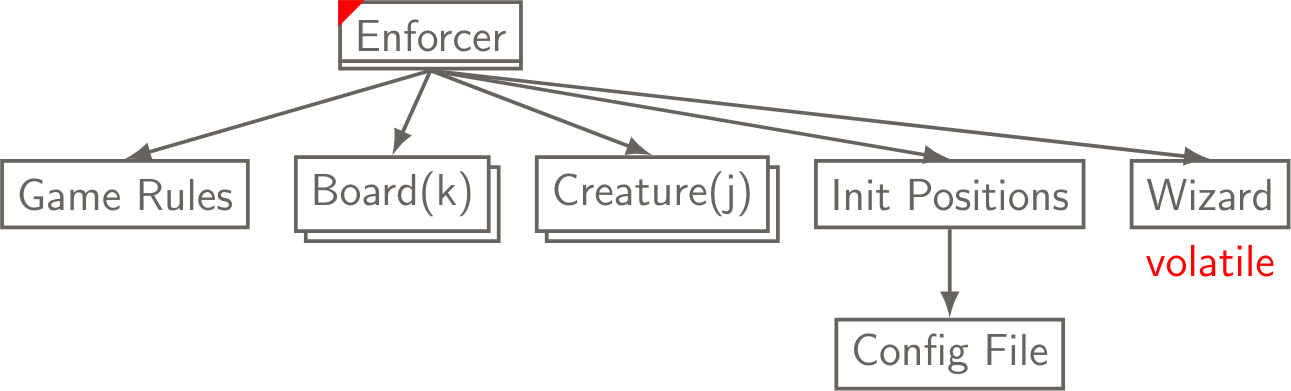
  • Consider a new version of LiveChess:
    • the board may change in size over time – no impact on the diagram
    • creatures may be born and may die – variable set of objects
    • new worlds may be created as additional board games – variable set of objects
    • a wizard may materialize from time to time – typical configuration should include it

A Dynamic System

Architectural Patterns

  • An architectural pattern may be defined as a generic design which:
    • has some desirable property
    • solves some frequently encountered problem
    • offers a good starting point for a solution
    • provides a reusable structure applicable to some problem domain
  • Meta-level considerations are not immediately explicit in the structure alone
  • The basic object-oriented design is such a pattern which promotes:
    • information hiding
    • encapsulation

Functional Decomposition

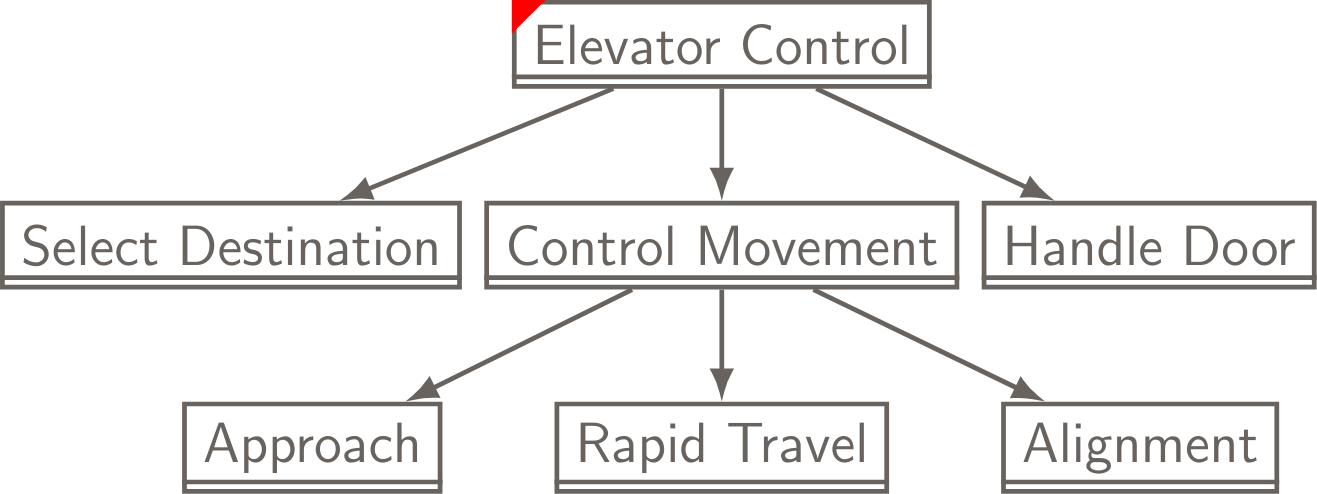
  • Functional decomposition may be employed in order to encapsulate policy decisions and to control the complexity of:
    • the processing logic
    • non-trivial methods
  • The relation defining the interactions among procedures is a reference, which constrains who can invoke whom

Functional Decomposition

Nested Objects

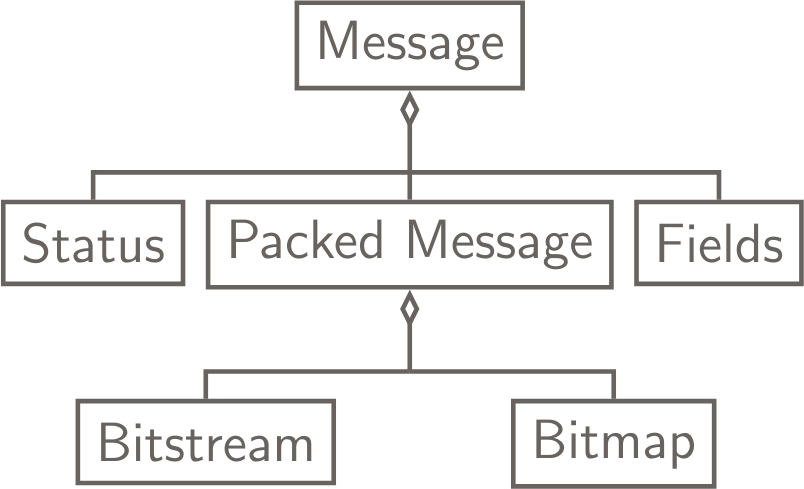
  • Nested objects are constructed strictly through the use of aggregation (tree structure)
    • each object can reference only its sub-components
    • it is desirable for sibling objects to be of similar complexity and level of abstraction
Shared Resources

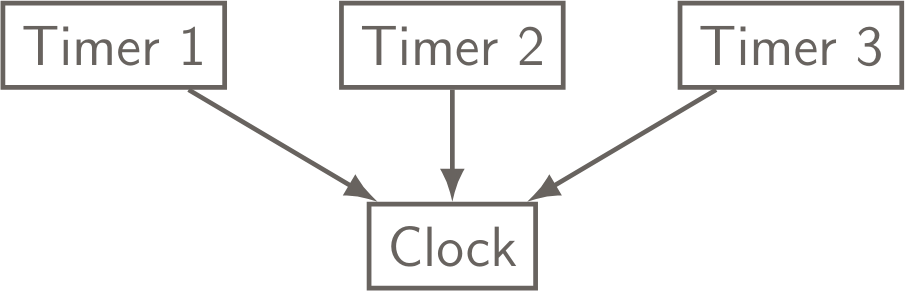
  • Object sharing is highly undesirable
  • When sharing cannot be avoided it should be minimized, structured, and made uniform
Transparent Sharing

  • Object sharing occurs when two or more objects have an acquaintance (reference) in common
  • Transparent sharing occurs when none of the objects involved can detect that sharing takes place
  • This is often the case when one physical interface supports several logical interfaces

Layered Objects

  • A layered object consists of a hierarchically organized set of objects
  • An object at one level can reference all objects on the level below
  • Sharing is not transparent
  • The level of abstraction decreases with depth

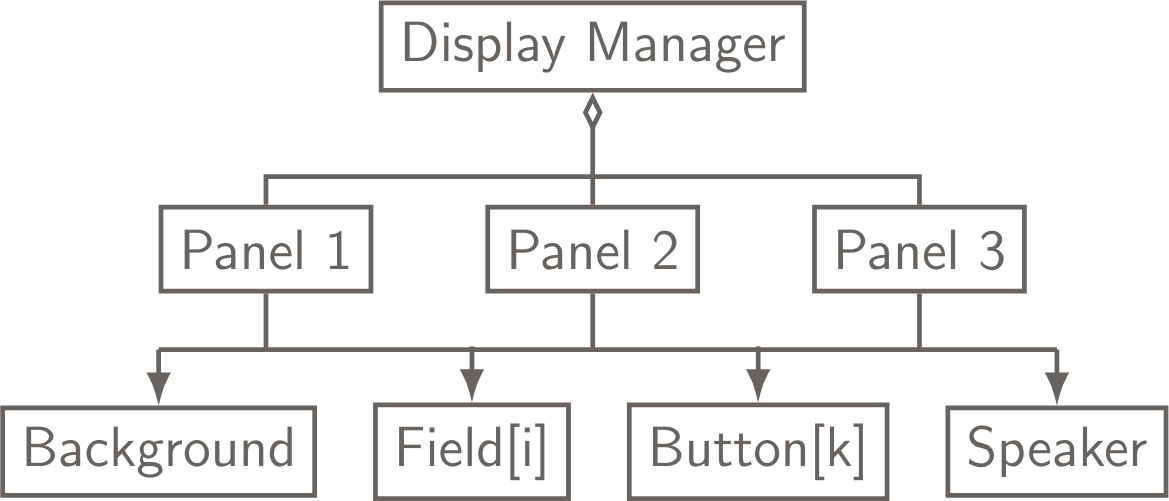
Layered object example

  • Dynamic restructuring
  • One panel is active at a time

Shared Implementation

  • Performance considerations often require objects which are essentially independent to be encapsulated in a single object managing their implementation
  • The desire for generality may also lead to shared implementations

Object Veneer

  • Legacy code need not be an impediment in the application of object-oriented design
  • Existing code can be encapsulated as a set of objects which are available to the remainder of the system