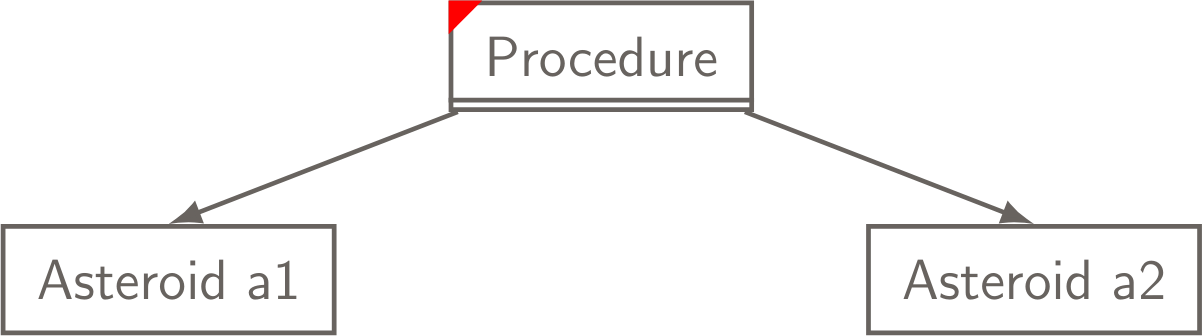
Lecture 05 ADT
Joseph Haugh
University of New Mexico
Free Recall
- Get out a sheet of paper or open a text editor
- For 2 minutes write down whatever comes to mind about the last class
- This could be topics you learned
- Questions you had
- Connections you made
Data Abstraction Revisited
- Built-in data types (int, boolean, etc.)
- Programmer-defined types
- Abstract data type (ADT)
- A formal characterization of a set of data structures sharing a common set of operations
- Generic types (parameterized definitions)
Abstract Data Type Definition
- A formal characterization of a set of data structures that share a common set of operations having well-defined syntax and semantics.
- An ADT specification:
- Is independent of any possible realization
- May be captured in purely mathematical terms
- The ADT is the conceptual basis for the class construct
Related Topics
- Abstraction: Omitting or hiding low-level details with a simpler, higher-level idea.
- Modularity: Dividing a system into components or modules, each of which can be designed, implemented, tested, reasoned about, and reused separately from the rest of the system.
- Encapsulation: Building walls around a module (a hard shell or capsule) so that the module is responsible for its own internal behavior, and bugs in other parts of the system can’t damage its integrity.
Related Topics Cont.
- Information hiding: Hiding details of a module’s implementation from the rest of the system, so that those details can be changed later without changing the rest of the system.
- Separation of concerns: Making a feature (or “concern”) the responsibility of a single module, rather than spreading it across multiple modules.
Basic Class Concept
- The notion of class assumes many forms:
- Mathematics: collection of sets sharing some property
- Natural language concept: collection of objects sharing some properties (red, car, birds, etc.)
- Design notation: documentation of a set of objects having identical properties
- Does not depend on availability of an object-oriented programming language
- Programming language construct
Class Construct in Java
- Embodiment of the abstract data type concept
- Fields
- Methods
- Mechanisms for deriving new classes:
- Inheritance
- Single (extending a class)
- Multiple (implementing interfaces)
- New fields and methods
- Method overriding
- Inheritance controls (final)
- Inheritance
- Access control mechanics: public, private, protected
Sample Class Definition
public class Asteroid {
    private static int nextid = 0;
    private int id;
    private Color color;
    private Point location;
    private int[] velocity;

    public Asteroid(Color color, Point location, int[] velocity) {
        this.color = color;
        this.location = location;
        this.velocity = velocity;
        this.id = nextid;
        nextid++;
    }
    public void updateLocation(int elapsedTime) {
    // ...
    }

    public void setVelocity(int[] velocity) {
        velocity = velocity;
    }

    public int[] getVelocity() { return velocity; }
    public Point getLocation() { return location; }
}
OOD Perspective
- Class as a strict embodiment of the abstract data type concept
- Private fields
- Public methods
- Restricted mechanisms for deriving new classes:
- Inheritance
- Single (extending a class)
- Multiple (implementing interfaces)
- Method overriding subject to semantic consistency
- Inheritance
Object Creation
- Objects are dynamically created instances of a class
- Storage is allocated for the fields
- Code is reused from the class definition
- Java uses garbage collection to reclaim storage used by inaccessible objects
Notation for Instantiation
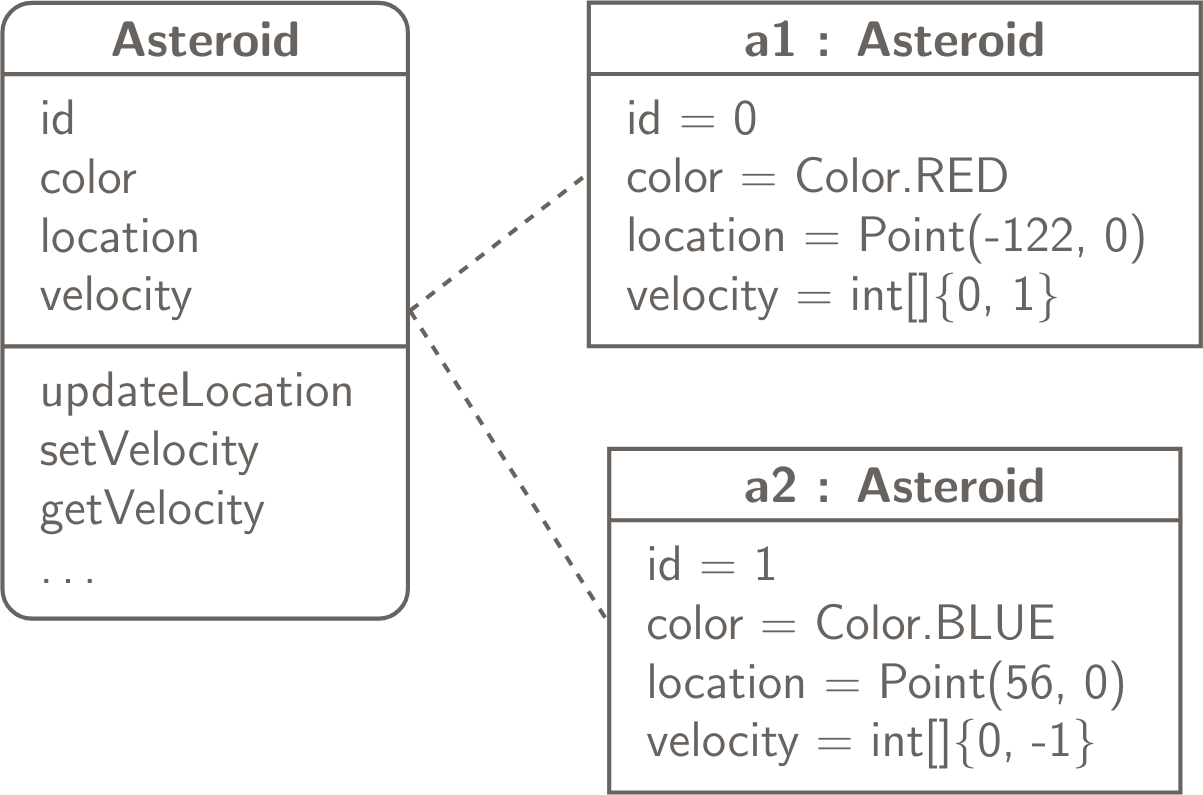
Simple Design Diagram