For 2 minutes write down whatever comes to mind about the last class
This could be topics you learned
Questions you had
Connections you made
Class Construct
Class is the fundamental programming concept in Java
fields
methods
modifiers
public vs private vs protected
static
final
abstract
Programs are structured in terms of classes
Objects are instances of classes
Execution entails the creation and manipulation of objects
Class Definition
A class can be defined in several ways:
by defining the fields and methods it provides
by implementing an existing interface
by extending an existing class
If class C extends class S
C is called a subclass, derived class, or child class
S is called a superclass, base class, or parent class
Cinherits all the fields and methods associated with S
C can add fields and methods
C can override methods (and hide fields) but they can still be accessed by referring to super
Inheritance Illustrated
Manager jane = new Manager();
jane.setSalary(120000.0);
jane.setBonus(50000.0);
System.out.println(jane.getSalary());
What is the intended control flow?
Inheritance Illustrated
public class Employee {
    private double sal;

    public void setSalary(double sal) {
        this.sal = sal;
    }

    public double getSalary() {
        return sal;
    }
}
public class Manager extends Employee {
    private double bonus = 0;

    public void setBonus(double amt) {
        bonus = amt;
    }

    public double getSalary() {
        return sal + bonus;
    }
}
What is the error?
Inheritance Illustrated
public class Employee {
    private double sal;

    public void setSalary(double sal) {
        this.sal = sal;
    }

    public double getSalary() {
        return sal;
    }
}
public class Manager extends Employee {
    private double bonus = 0;

    public void setBonus(double amt) {
        bonus = amt;
    }

    public double getSalary() {
        // sal field not visible
        return sal + bonus;
    }
}
What is the error?
Inheritance Illustrated
public class Employee {
    private double sal;

    public void setSalary(double sal) {
        this.sal = sal;
    }

    public double getSalary() {
        return sal;
    }
}
public class Manager extends Employee {
    private double bonus = 0;

    public void setBonus(double amt) {
        bonus = amt;
    }

    public double getSalary() {
        return getSalary() + bonus;
    }
}
What is the error? Fixed?
Inheritance Illustrated
public class Employee {
    private double sal;

    public void setSalary(double sal) {
        this.sal = sal;
    }

    public double getSalary() {
        return sal;
    }
}
public class Manager extends Employee {
    private double bonus = 0;

    public void setBonus(double amt) {
        bonus = amt;
    }

    public double getSalary() {
        // Infinite recursion
        return getSalary() + bonus;
    }
}
What is the error? Fixed?
Inheritance Illustrated
public class Employee {
    private double sal;

    public void setSalary(double sal) {
        this.sal = sal;
    }

    public double getSalary() {
        return sal;
    }
}
public class Manager extends Employee {
    private double bonus = 0;

    public void setBonus(double amt) {
        bonus = amt;
    }

    public double getSalary() {
        return super.getSalary() + bonus;
    }
}
What is the error? Fixed?
Case Study: Credit Union
Consider a system that supports the basic operations of a Credit Union:
manage membership in the credit union by adding and removing individual members
manage accounts
account creation and closing
deposit and withdrawal of funds
fund transfers among accounts belonging to the same member
accept and process transaction requests originating with the bank teller
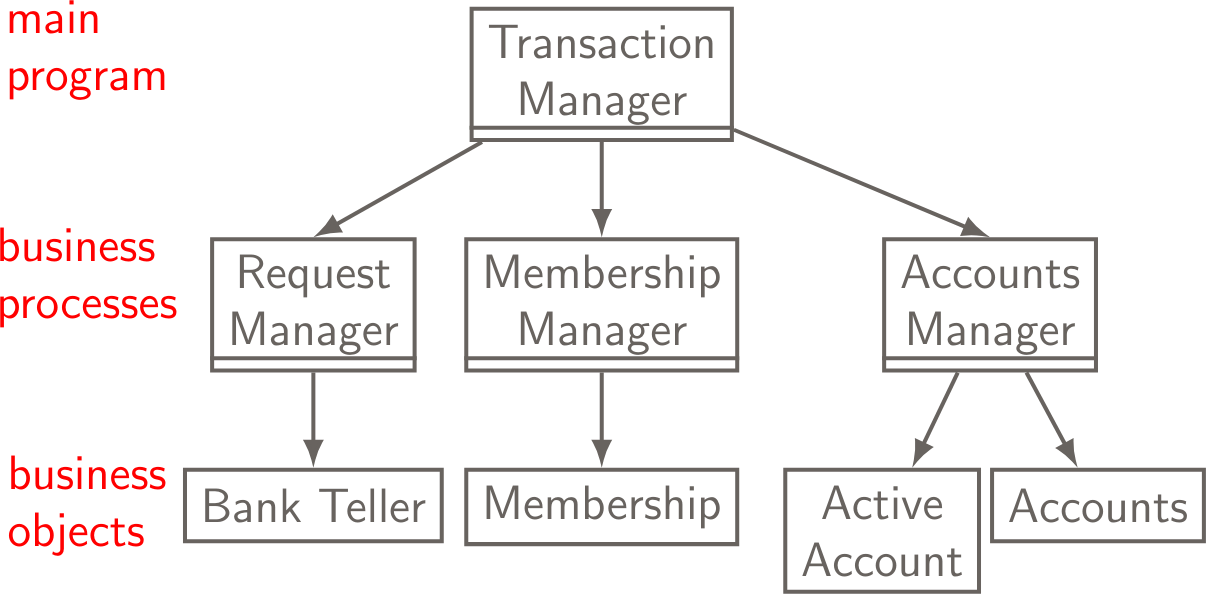
Representative Design Solution
Coding Tasks
Define application-specific data types
tailored to the application
used consistently across the system
simplifying the programming task
Code procedures and limit access by controlling scope
Build classes required to manage the object portfolio
User-Defined Types
Basic application concepts are abstracted as user-defined data types
ensure continuity with the requirements level
simplify programming
Such types can vary in complexity
class with multiple public fields
class with multiple private fields and extractor methods
class with private fields and public methods
User-Defined Types: AccountId & TransactionType
AccountId – member account identification
last name (capitalized, single name)
account number (9 digits)
public class AccountId {
    private String lastName;
    private double accountNumber;
}
TransactionType – transaction request type
create, delete, deposit, withdraw, transfer
public enum TransactionType {
    CREATE, DELETE, DEPOSIT, WITHDRAW, TRANSFER
}
Main Program
For now: The main program defines the starting point for the entire application
may or may not be terminating
controls the sequencing of operations
may employ local variables for temporary use
retains little or no information
public class TransactionManager {
    public static void main(String[] args) {
    // ...
    }
}
Functional Decomposition
Traditionally, modularity was achieved by means of top-down functional decomposition
main program embodies the entire functionality of the system
procedures at levels below decompose it into subfunctions or modules
clean design enforces a policy of
process encapsulation
balanced levels of abstraction
In object-oriented design, functional decomposition is present
at the top layers of the design
in the design of complex methods
Functional Decomposition: Transaction Manager
import managers.RequestManager;
import managers.MembershipManager;
import managers.AccountsManager;

public class TransactionManager {
    public static void main(String[] args) {
        RequestManager requestManager =
            new RequestManager();
        MembershipManager membershipManager =
            new MembershipManager();
        AccountsManager accountsManager =
            new AccountsManager();
        // ...
    }
}
Object Instantiation
A simple way to code an object:
define the right class
provide access to the class definition
instantiate one or more objects as needed
Define class Account inside AccountsManager
private fields: AccountId (last name, account number–type defined earlier) and balance
public methods: deposit(amount), debit(amount), balance(), accountType() – the last two digits of the account number
Create one or more instances within the body of the Accounts Manager
Inheritance & Specialization
Objects that relate to each other may still need to be different
Inheritance allows classes to extend a base class
the base class captures all the common features
the child class adds capabilities specific to an object subtype
Inheritance & Specialization: Account
Accounts can be of two types:
Checking – they receive a fixed dividend each month
Savings – they are credited a fixed interest based on the average balance of each month with the daily balance being determined at midnight each day
Inheritance & Specialization: Account
Design changes:
the Transaction Manager needs access to the system date and time
Sub-classing implications:
Checking requires a new method payDividend
Savings requires:
a new private field balanceHistory
a new public method updateHistory
a new public method postInterest
Specialization: Checking & Saving
public class Savings extends Account {
    private float[] balanceHistory;
    private int day;

    public void updateHistory() {
        // ...
    }

    public void postInterest() {
        // ...
    }
}
public class Checking extends Account {
    public void payDividend(float amount) {
        // ...
    }
}
Abstract Methods: Account Revisited
The Account class may require a method backup
the actual implementation is account type and system specific
The solution is to define backup as an abstract method
force Checking and Savings to provide the details
allow the two subclasses to have different backup approaches, if needed
public abstract class Account {
    public abstract void backup();
    // ...
}
No overall design changes required
Implementing Interfaces
An interface is a class that provides no implementation for its methods
no code to execute
A derived class can extend a single base class
for implementation reasons
A class may implement multiple interfaces
MyClass implements Interface1, Interface2
Implementing Interfaces: Another Perspective on Account
Some of the requirements on the definition of Account:
may be related to being a bank account
may be related to being an insured account
Different requirements can be captured by different interfaces
Implementing Interfaces: Another Perspective on Account
public interface BankAccount {
    // ...
}
public interface InsuredAccount {
    void debitFee();
    // ...
}
public abstract class Account implements BankAccount, InsuredAccount {
    public abstract void backup();
    // ...
}
Aggregation & Object Composition
Complex objects are constructed through object composition
the methods of the composite object are coded using methods of nested objects
these subordinate objects are private
these subordinate objects should be independent of each other
the relation between the composite and subordinate objects is called aggregation
this relation between the objects is created by proper composition of classes
Hiding: Minor
One form of specialization entails hiding methods of the superclass
method is overridden to generate exception if invoked
public class MinorSavings extends Savings {
    @Override
    public void withdraw(float amount) throws TransactionException {
        throw new TransactionException("Minors are "
        + "not permitted to withdraw "
        + "from savings accounts.");
    }
}
Designing with Classes
The philosophy of this course:
focus on design
exploit language features to realize the design
keep the design language-independent
Implementation does not require an object-oriented language
A design strategy that is class-centered (often used in practice)