Lecture 14 Command
Joseph Haugh
University of New Mexico
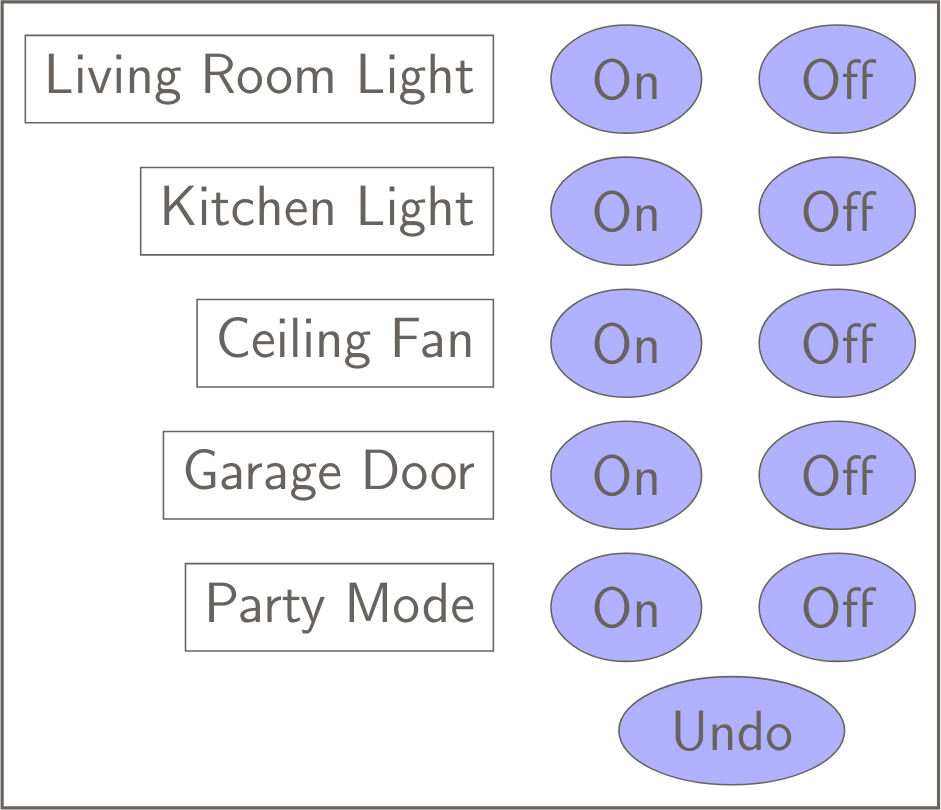
The Mission: A Remote Control
- Remote has multiple programmable slots. We can associate each with a different device.
- Each slot has on and off buttons.
- Remote has a global undo button.
- Vendors have provided classes to control home automation devices.
- Can we make an API for programming the remote?
The Remote Control

The Vendor Classes
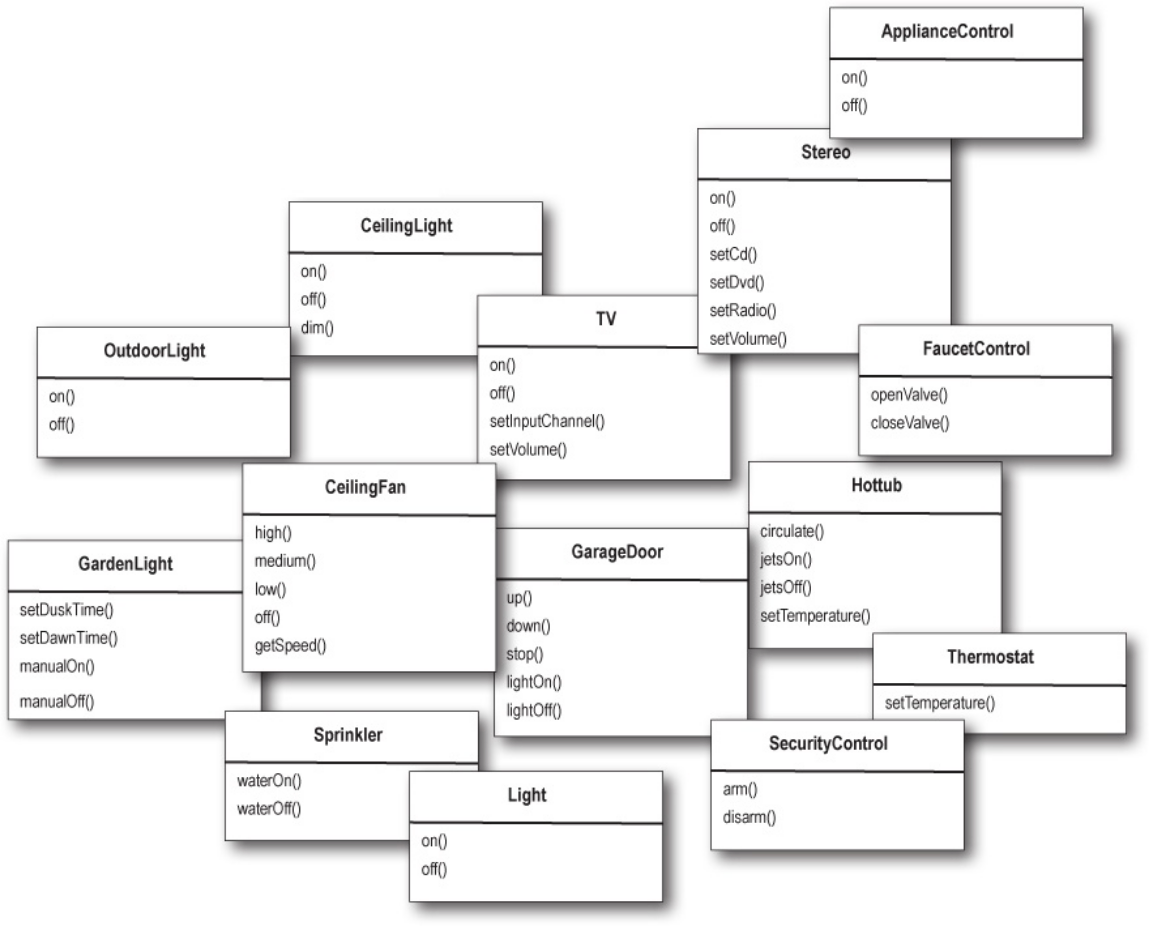
Towards a Design
- The remote is simple, but the devices are not!
- So many different method names!
- We need some information hiding and separation of concerns
- The remote shouldn’t have a bunch of switch statements that select between devices…
- We really need to decouple the requester of the action from the object that performs the action
Command Objects (in context)
- We introduce command objects into the design
- A command object encapsulates a request to do something (e.g., turn on a light) on a specific object (e.g., the living room lamp)
- We can then just store a command object for each button such that when the button is pressed, the command is invoked
- The button doesn’t have to know anything about the command
An Analogy: Ordering in a Diner
- The customer gives the server their order.
- The server takes the order, places it on the counter, and says “Order up!”
- The short-order cook prepares the meal from the order.
An Analogy: Ordering in a Diner
- The customer gives the server their order.
- An order slip encapsulates a request to prepare a meal.
- Its method orderUp() encapsulates the actions needed to prepare the meal; it also carries its own reference to the appropriate Cook
- The server takes the order, places it on the counter, and says “Order up!”
- The short-order cook prepares the meal from the order.
An Analogy: Ordering in a Diner
- The customer gives the server their order.
- An order slip encapsulates a request to prepare a meal.
- Its method orderUp() encapsulates the actions needed to prepare the meal; it also carries its own reference to the appropriate Cook
- The server takes the order, places it on the counter, and says “Order up!”
- The server just creates order slips and invokes the orderUp() method.
- The short-order cook prepares the meal from the order.
An Analogy: Ordering in a Diner
- The customer gives the server their order.
- An order slip encapsulates a request to prepare a meal.
- Its method orderUp() encapsulates the actions needed to prepare the meal; it also carries its own reference to the appropriate Cook
- The server takes the order, places it on the counter, and says “Order up!”
- The server just creates order slips and invokes the orderUp() method.
- The short-order cook prepares the meal from the order.
- The Cook knows how to prepare the meals; but he’s completely decoupled from the server (they never directly communicate)
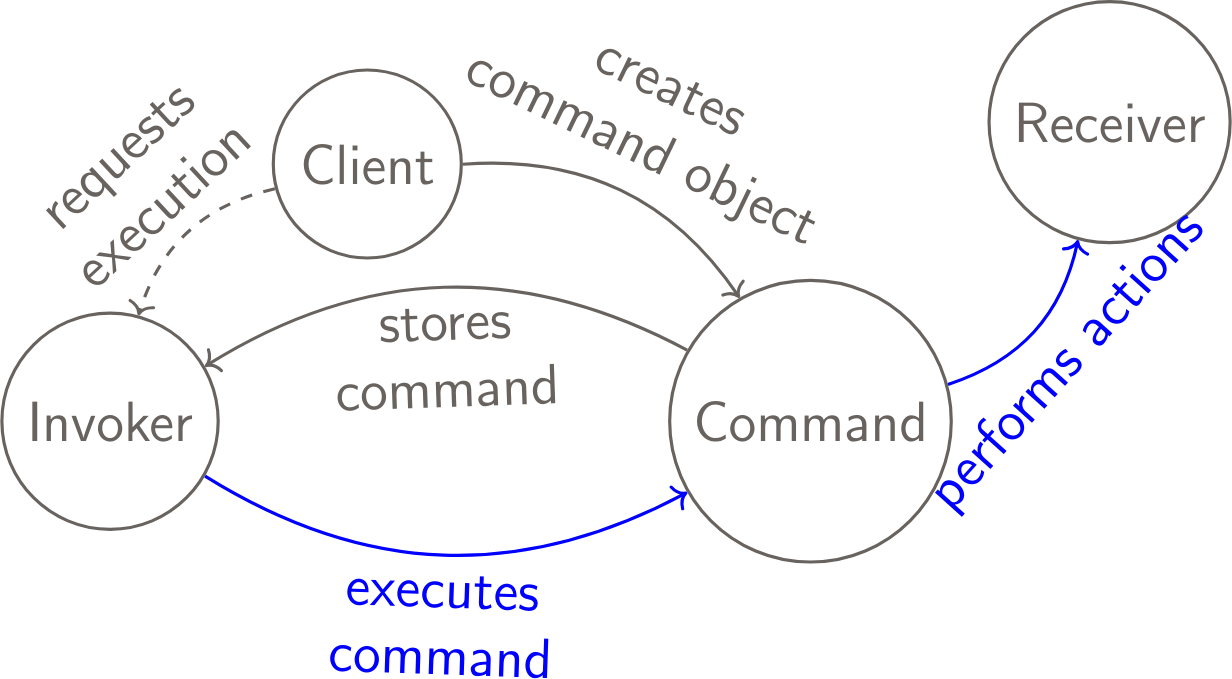
The Command Pattern in General
- Client: creates command object
- Invoker: stores command, requests execution
- Command: executes command
- Receiver: performs actions
The Command Pattern in General
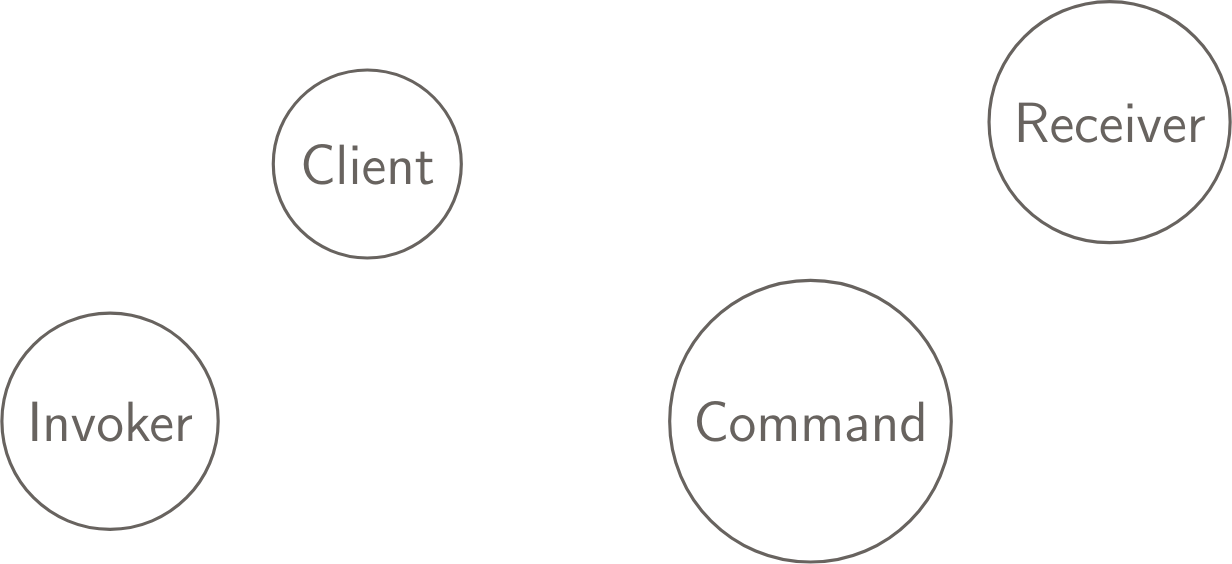
The Command Pattern in General
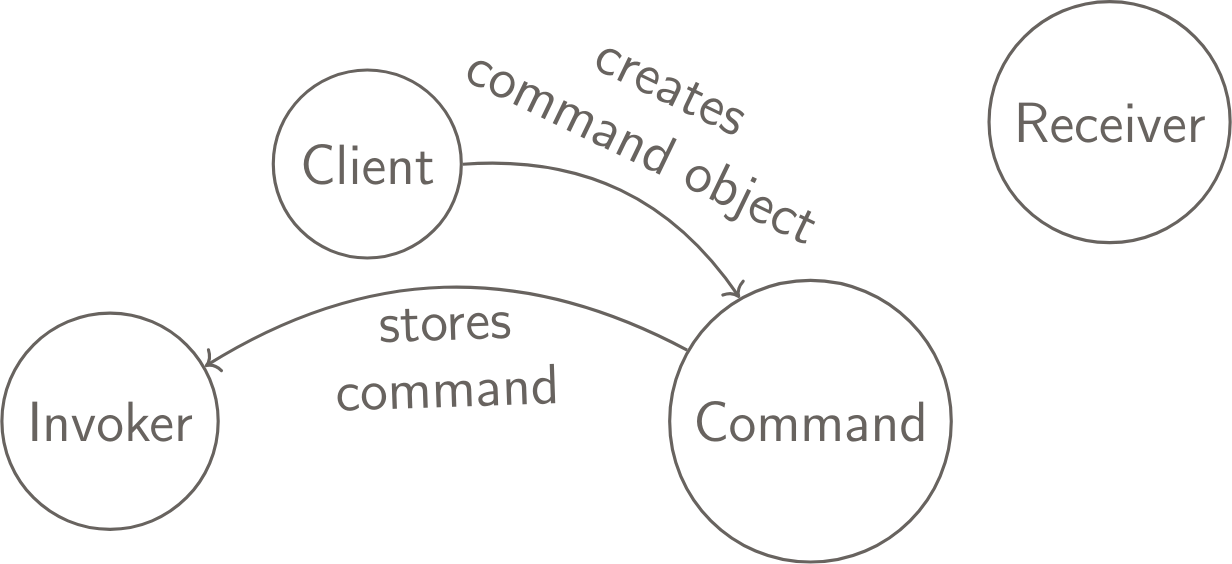
The Command Pattern in General
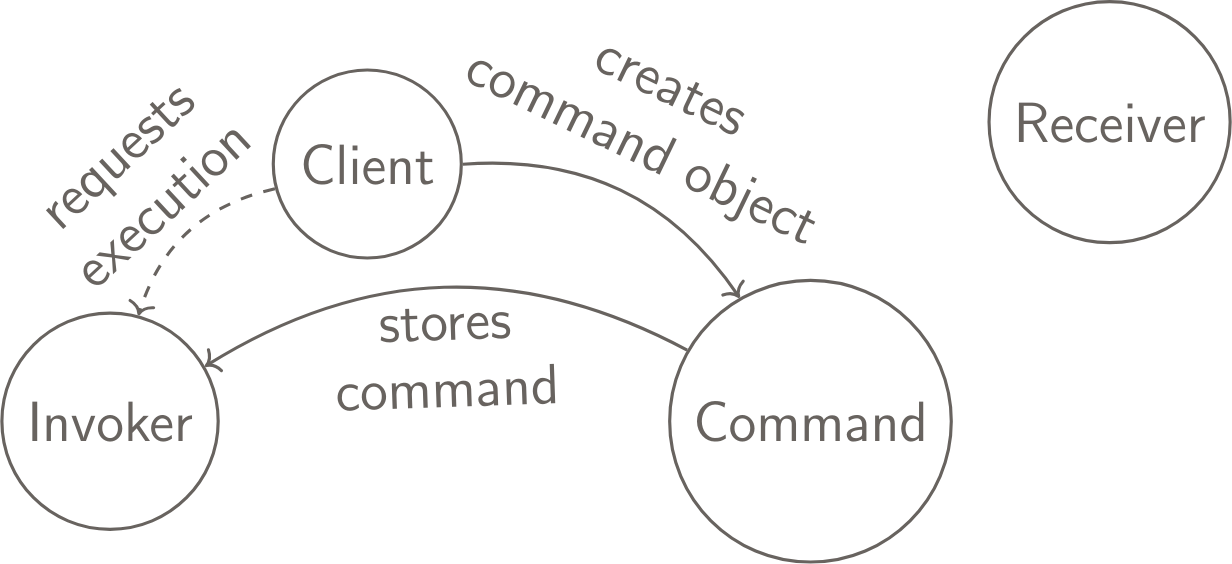
The Command Pattern in General
Back To The Analogy
- How does the previous analogy fit into this framework?
- Client: the customer
- Invoker: the server
- Command: the order
- Receiver: the cook
A First Command Object (Command)
public interface Command {
    public void execute ();
}
public class LightOnCommand implements Command {
private Light light;
public LightOnCommand (Light light) {
this.light = light;
}
public void execute () {
light.on();
}
}A First Command Object (Invoker)
public class SimpleRemoteControl {
    private Command slot;

    public SimpleRemoteControl () { }

    public void setCommand(Command command) {
        slot = command;
    }

    public void buttonWasPressed() {
        slot.execute();
    }
}
A Simple Test of the Remote (Client)
public class RemoteControlTest {
    public static void main(String[] args) {
        SimpleRemoteControl remote = new SimpleRemoteControl();

        Light light = new Light();

        LightOnCommand lightOn = new LightOnCommand(light);

        remote.setCommand(lightOn);
        remote.buttonWasPressed();
    }
}
The Command Pattern
The Command Pattern encapsulates a request as an object, thereby letting you parameterize other objects with different requests, queue or log requests, and support undo-able operations.
The Command Pattern
- The command object encapsulates a request by binding together a set of actions on a specific receiver.
- Command object only exposes the execute method.
- When execute is called, causes actions to be invoked on receiver.
- Other objects don’t know what actions get performed on what receiver;
- They just know that their request will be serviced if they call execute.
Back to our Remote. . .
Question
- How does the remote know the difference between the kitchen light and the living room light?
- It doesn’t have to! The Receiver is encapsulated in the command that is inserted in the slot.
Let’s Add Support for the Undo Button
First, we need to expand the
Commandinterface:public interface Command { public void execute(); public void undo(); }Now every command must also be undo-able
Let’s Add Support for the Undo Button
- So we add an implementation for undo() for every command that we implement
- E.g., for LightOnCommand, undo() simply calls light.off()
- Some undo() method implementations are more complicated
- e.g., undoing a change in speed of a ceiling fan
- All that’s left is to add support to the remote control to handle tracking which undo() method to call
- Store the last command executed
- if the undo button is pressed, we can just invoke the undo() method on that command
Remote with Undo
public class RemoteControl {
    private Command[] slots = new Command[10];
    private Command recent;

    public void setCommand(int index, Command command) {
        slot[index] = command;
    }

    public void buttonWasPressed(int index) {
        slot[index].execute();
        recent = slot[index];
    }

    public void undoWasPressed() {
        if(recent != null) {
            recent.undo();
        }
    }
}
Remote with Undo History
public class RemoteControl {
    private Command[] slots = new Command[10];
    private Deque<Command> stack = new LinkedList<>;

    public void setCommand(int index, Command command) {
        slot[index] = command;
    }

    public void buttonWasPressed(int index) {
        slot[index].execute();
        stack.push(slot[index]);
    }

    public void undoWasPressed() {
        if(!stack.isEmpty()) {
            Command recent = stack.pop();
            recent.undo();
        }
    }
}
Strategy Vs. Command
Strategy specifies how something should be done - Merge vs Bubble sort - Probabilistic vs Deterministic primality tests - Doing the same action just in a different way
Command specifies what should be done - Faucet On or Off - Open or Close door - Doing a different action