Lecture 15 Adapter
Joseph Haugh
University of New Mexico
The Adapter Analogy

The OO Adapter

The OO Adapter

The OO Adapter
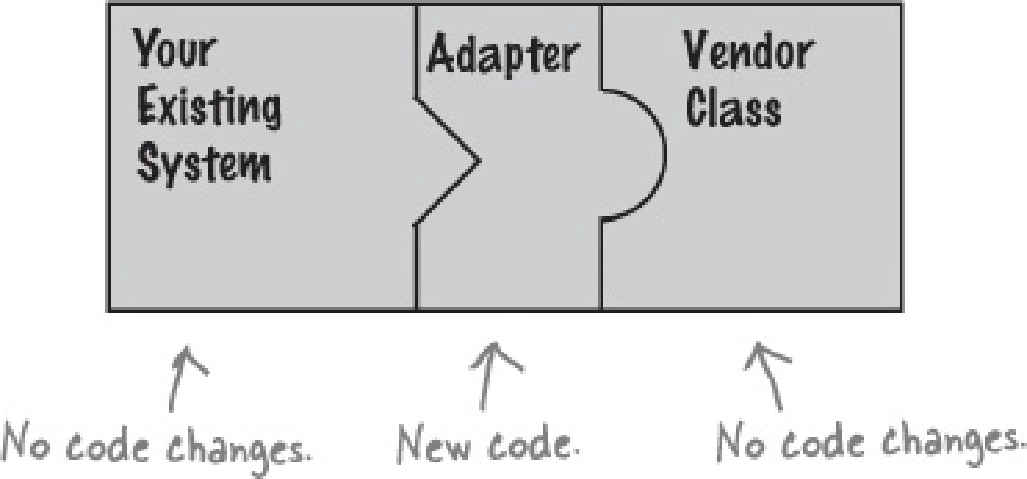
Writing an Adapter
Back to Ducks, but with interfaces now
public interface Duck {
    public void quack();
    public void fly();
}
public class MallardDuck implements Duck {
public void quack() {
System.out.println("Quack");
}
public void fly() {
System.out.println("I'm flying!");
}
}A New Fowl…
public interface Turkey {
    public void gobble();
    public void fly();
}
public class WildTurkey implements Turkey {
public void gobble() {
System.out.println("Gobble gobble");
}
public void fly() {
System.out.println("I'm flying a short amount!");
}
}Here’s my problem…
- I need ducks
- But what I have are turkeys
- Is there any way to turn a turkey into a duck?
TurkeyAdapter
public class TurkeyAdapter implements Duck {
    private Turkey turkey;

    public TurkeyAdapter(Turkey turkey) {
        this.turkey = turkey;
    }

    public void quack() {
        turkey.gobble();
    }

    public void fly() {
        for(int i = 0; i < 5; i++) {
            turkey.fly();
        }
    }
}
The Adapter Pieces
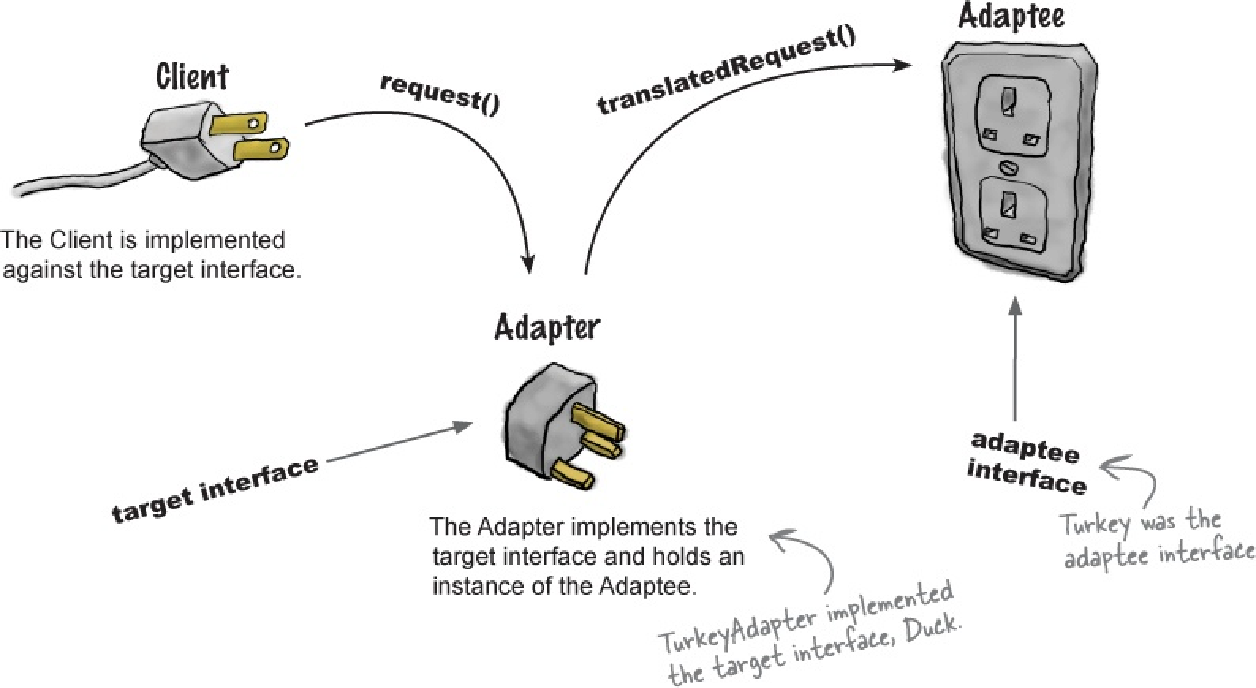
Questions
- How much adapting can be done in an adapter?
- That really depends on the particular situation and the particular interfaces.
- It could be just basic translation or massive amounts of work
- Does an adapter always wrap only one class?
- The real world can be messier; an adapter could wrap two or more adaptees needed to implement the target interface
- However, the Adapter always converts one interface to another (the point is just that the definition of “interface” may not be limited to a single class)
The Adapter Pattern
- The Adapter Pattern converts the interface of a class into another interface the client expects.
- Adapter lets classes work together that couldn’t otherwise because of incompatible interfaces.
The Adapter Class Diagram
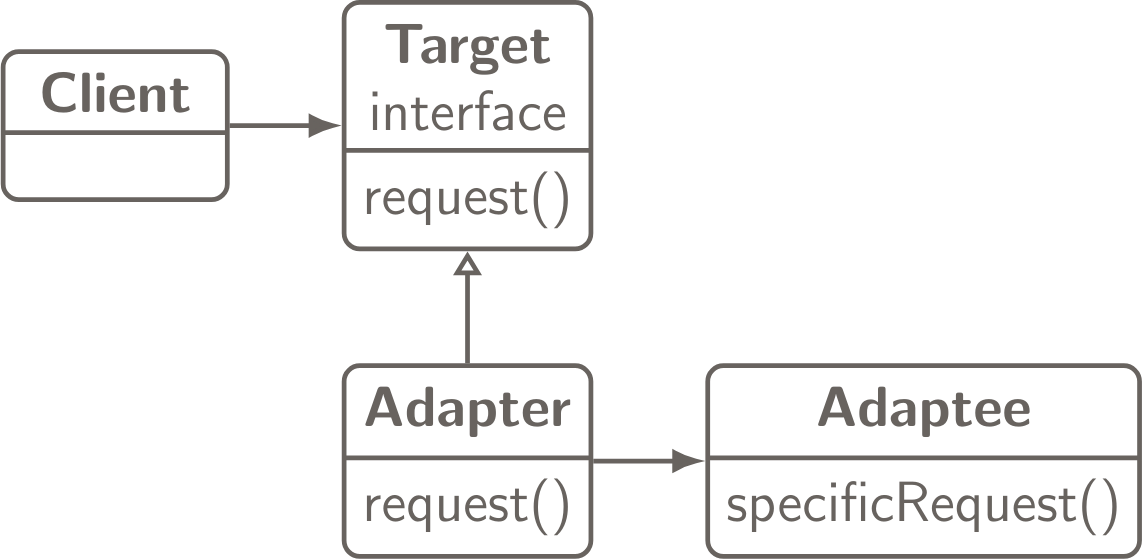
Adapter Pattern and Good OO Design
- Favor composition
- The adaptee is wrapped with an altered interface using composition
- Programming to an interface not an implementation
- The client is only aware of the target interface
An Example Adapter in the Wild
- Old World Enumerations…
- Early Java “collections” types implemented an elements() method that you could then step through without knowing how the collection was implemented
- New World Iterators…
- The Collections classes use an Iterator that implements a similar capability but also allows item removal
- Never the twain shall meet
- Oh, wait…
Backwards Compatibility
- You know what that means, right?
- We often have to work with legacy code that does it the old way.
- But our clients insist (and they should) on using the new way.
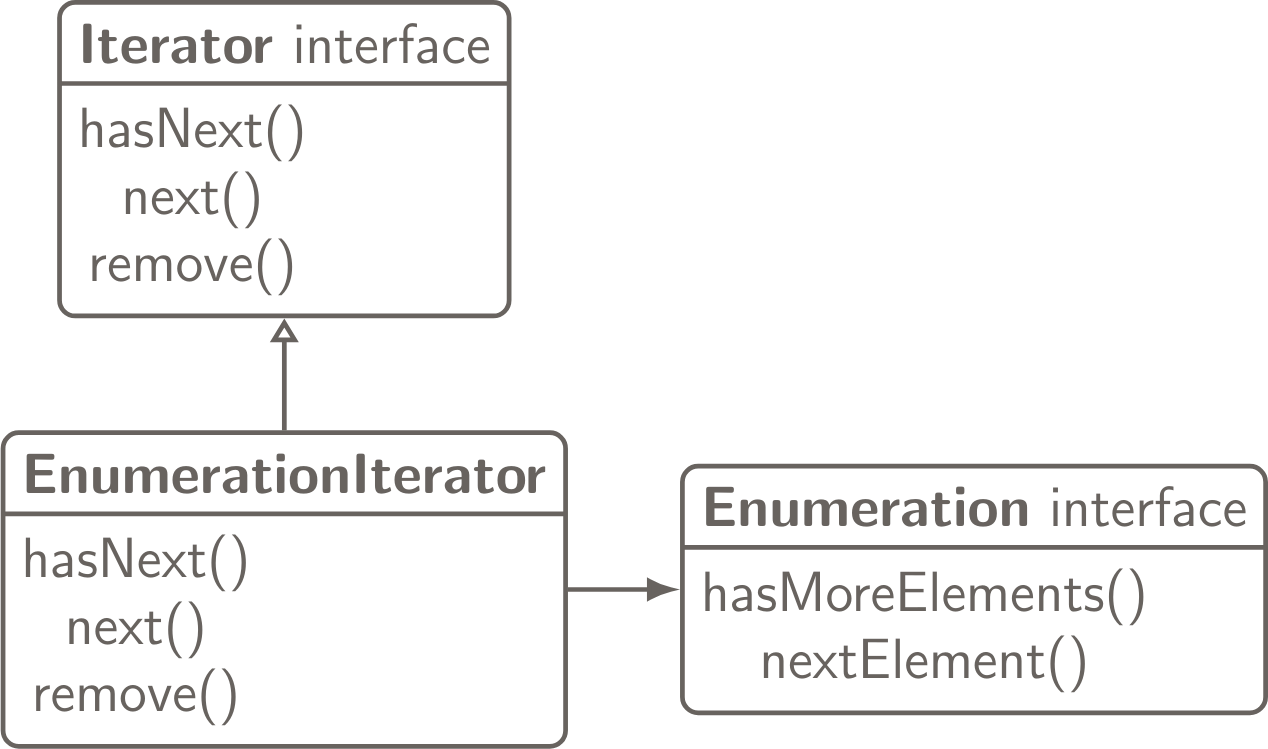
Let’s Examine the Interfaces
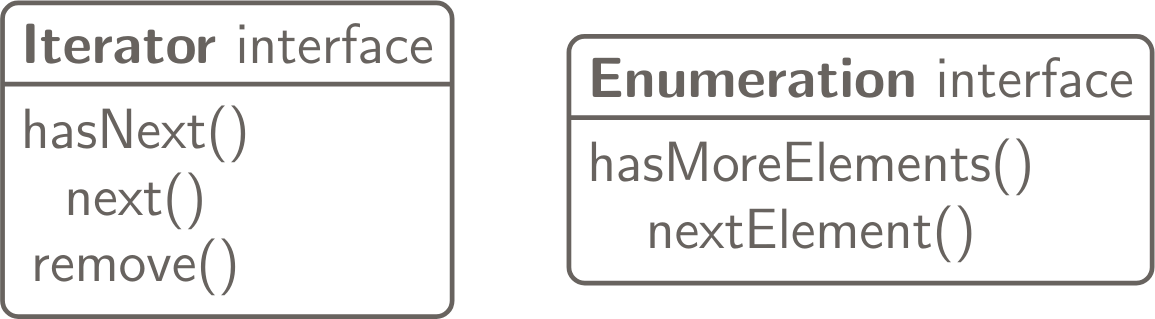
The Class Diagram
How to Handle the remove() method
- Enumeration simply doesn’t support remove
- It’s “read only”
- We can, however, throw a runtime exception if someone tries to call
remove()on anEnumerationIterator- The Iterator class supports this
- It’s remove method supports throwing an UnsupportedOperationException
- In the end, the adapter isn’t perfect
- Clients will still have to deal with potential exceptions
The EnumerationIterator Adapter
public class EnumerationIterator implements Iterator {
    private Enumeration en;

    public EnumerationIterator(Enumeration en) {
        this.en = en;
    }

    public boolean hasNext() {
        return en.hasMoreElements();
    }

    public Object next() {
        return en.nextElement();
    }

    public void remove() {
        throw new UnsupportedOperationException();
    }
}
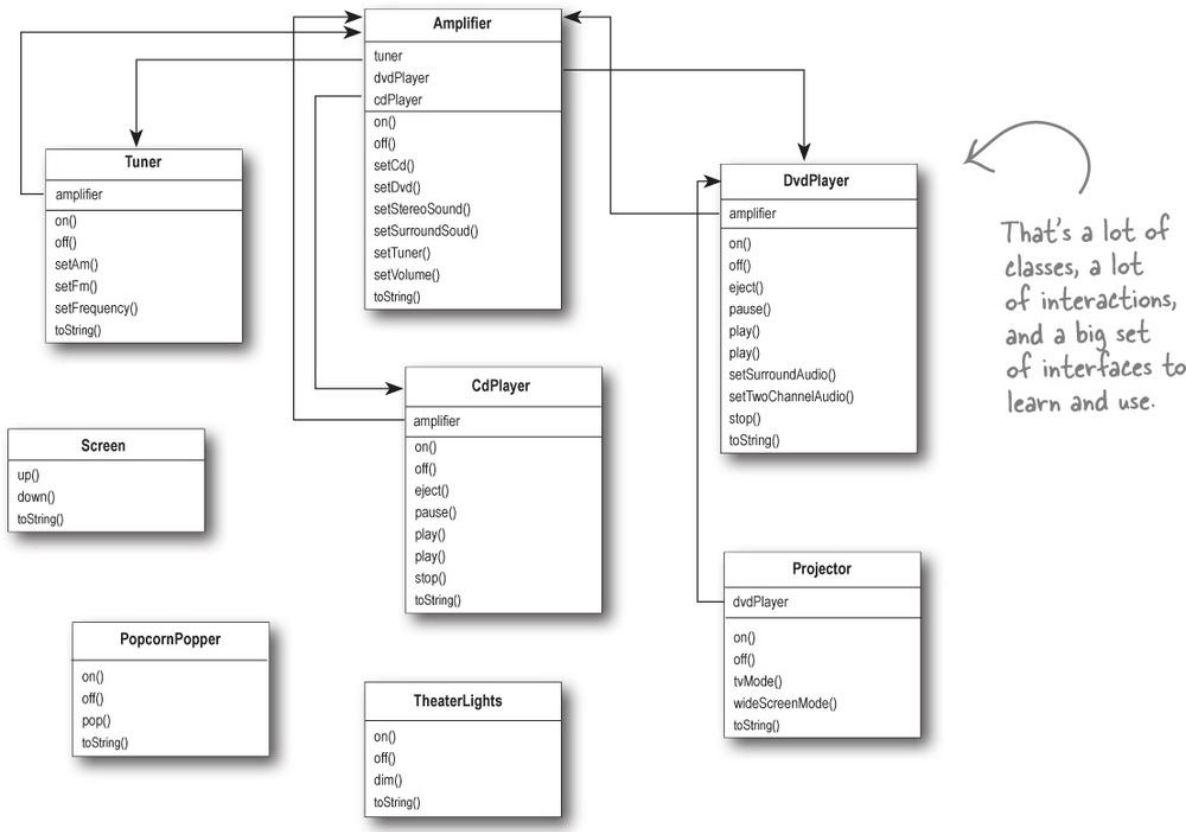
A Home Theater
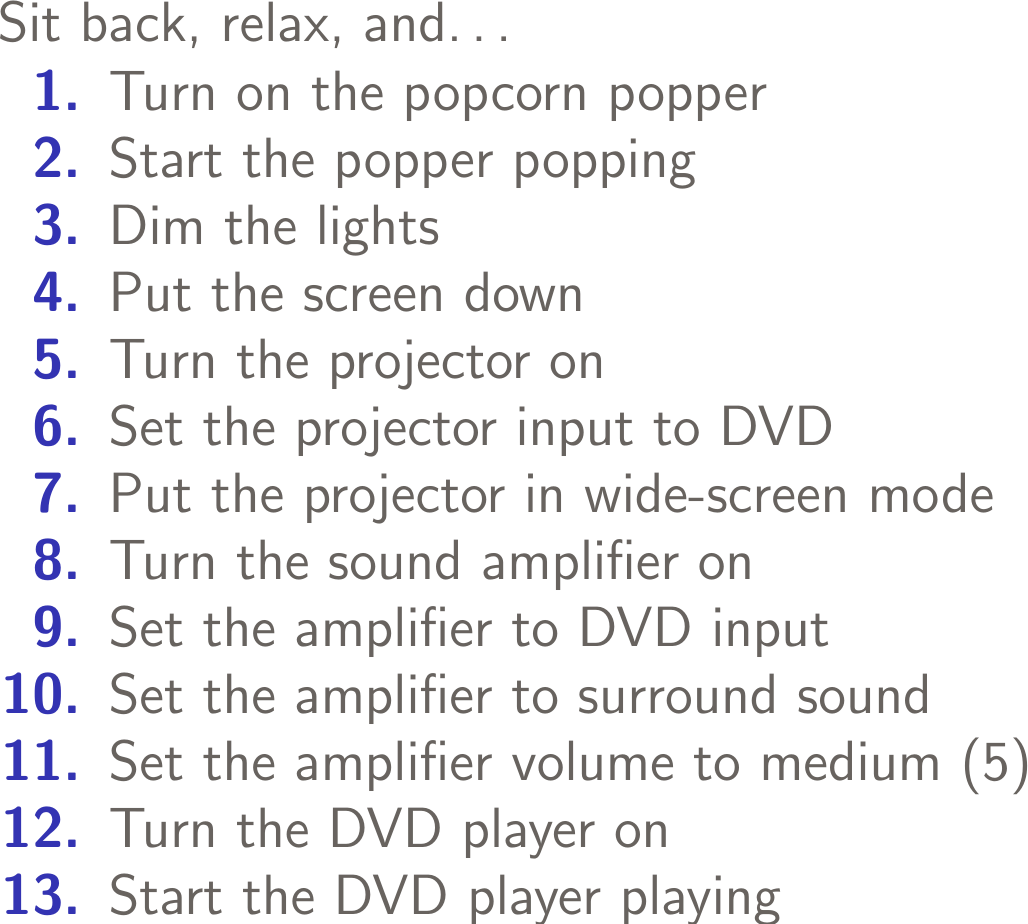
Watching a Movie
Further Complications…
- When the movie finishes, you have to do it all in reverse!
- Doing a slightly different task (e.g., listen to streaming audio) is equally complex
- When you upgrade your system, you have to learn a slightly different procedure
Home Theater Facade
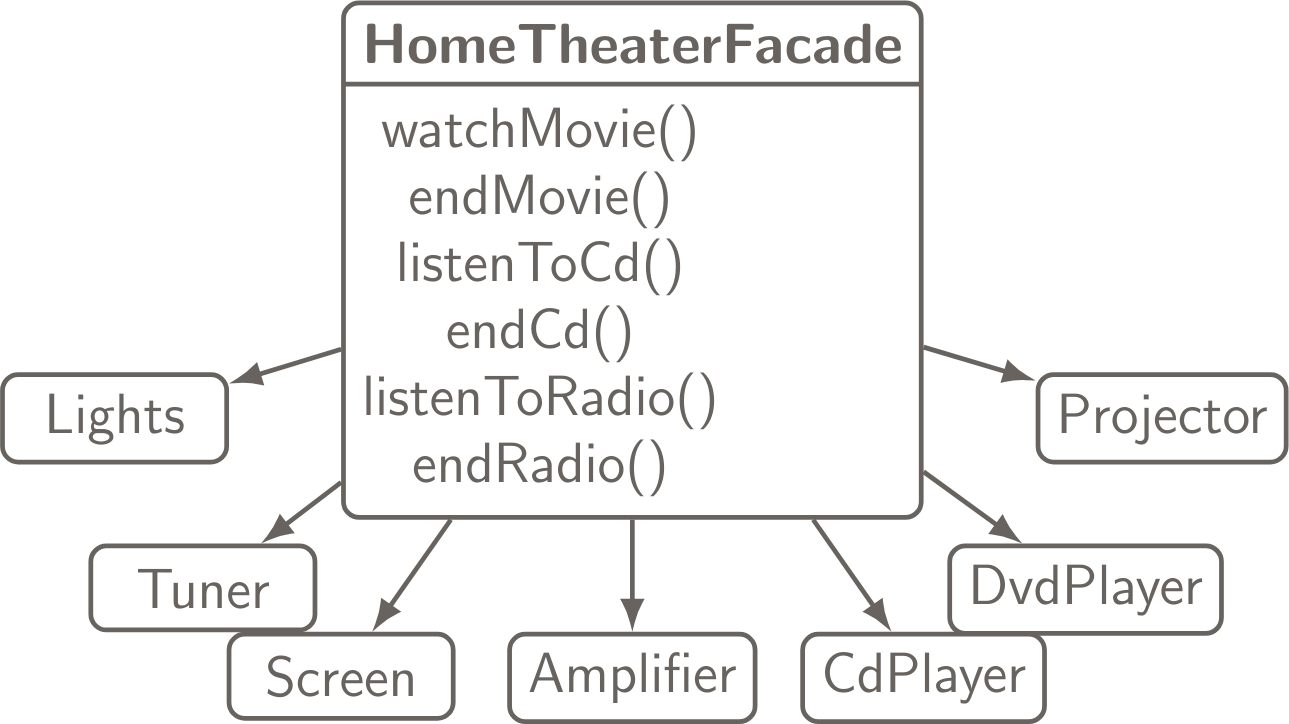
- Time to create a Facade for the home theater system.
- We create a new class
HomeTheaterFacade, which exposes a few simple methods such aswatchMovie() - The Facade class treats the home theater components as a subsystem, and calls on the subsystem to implement its
watchMovie()method
Home Theater Facade
Sidebar: Facade vs Adapter
- A facade not only simplifies an interface, but it also decouples a client from a subsystem of components
- Facades and adapters may wrap multiple classes
- A facade’s intent is to simplify
- An adapter’s intent is to convert the interface into something different
- A facade does not encapsulate
- it just provides a simplified interface
Home Theater Facade
public class HomeTheaterFacade {
    private Amplifier amp;
    private Tuner tuner;
    private DvdPlayer dvd;
    private CdPlayer cd;
    private Projector projector;
    private TheaterLights lights;
    private Screen screen;
    private PopcornPopper popper;

    public HomeTheaterFacade(Amplifier amp, Tuner tuner,
                             DvdPlayer dvd, CdPlayer cd,
                             Projector projector,
                             TheaterLights lights, Screen screen,
                             PopcornPopper popper) {
        amp = amp;
        tuner = tuner;
        dvd = dvd;
        cd = cd;
        projector = projector;
        lights = lights;
        screen = screen;
        popper = popper;
    }
}
Home Theater Facade
public void watchMovie(String movie) {
    System.out.println("Get ready to watch a movie");
    popper.on();
    popper.pop();
    lights.dim(10);
    screen.down();
    projector.on();
    projector.wideScreenMode();
    amp.on();
    amp.setDvd(dvd);
    amp.setSurroundSound();
    amp.setVolume(5);
    dvd.on();
    dvd.play(movie);
}
Home Theater Facade
public void endMovie() {
    System.out.println("Shutting movie theater down");
    popper.off();
    lights.on();
    screen.up();
    projector.off();
    amp.off();
    dvd.stop();
    dvd.eject();
    dvd.off();
}
The Facade Pattern
- The Facade Pattern provides a unified interface to a set of interfaces in a subsystem.
- Facade defines a higher-level interface that makes the subsystem easier to use.
A Sidebar: The Principle of Least Knowledge
- As a general design principle, you should reduce the interactions between objects to just a few “close friends”
- Be careful of the number of classes an object interacts with and also how it comes to interact with those classes
- Prevents creating designs that have a very high degree of coupling among classes (these systems are much more fragile)
A Sidebar: The Principle of Least Knowledge
- General guidelines:
- Only invoke methods that belong to
- The object itself
- Objects passed as parameters to the method
- Any object the method creates or instantiates
- Any components of the object
- Only invoke methods that belong to
- Do not invoke methods on objects that were returned from calling other methods!
An Example
Without the Principle:
public float getTemp() {
    Thermometer t = station.getThermometer();
    return t.getTemperature();
}
We get the thermometer object from the station and call the method ourselves.
With the Principle:
public float getTemp() {
    return station.getTemperature();
}
We add a method to the
Stationclass that makes a request to the thermometer for us, reducing the number of classes we’re dependent on.
Principle of Least Knowledge
- Advantages
- Reduces dependencies between objects, which has been demonstrated to reduce maintenance costs
- Disadvantages
- Results in more “wrapper” classes to avoid method calls to other components
- This can result in increased complexity and development time
Examples of Good Practice
public class Car {
    private Engine engine;

    public Car() {
        // initialize engine, etc.
    }

    public void start(Key key) {
        Doors doors = new Doors();
        boolean authorized = key.turns();
        if(authorized) {
            engine.start();
            updateDashboardDisplay();
            doors.lock();
        }
    }

    public void updateDashboardDisplay() {
        // update display
    }
}
Exercise
Does this violate the Principle of Least Knowledge?
public House {
    private WeatherStation station;

    // other methods and constructor

    public float getTemp() {
        return station.getThermometer().getTemperature();
    }
}
Exercise
Does this violate the Principle of Least Knowledge?
public House {
    private WeatherStation station;

    // other methods and constructor

    public float getTemp() {
        Thermometer therm = station.getThermometer();
        return getTempHelper(therm);
    }

    public float getTempHelper(Thermometer therm) {
        return therm.getTemperature();
    }
}
Facade and the Principle of Least Knowledge
- The client only has one friend, the
HomeTheaterFacade - The
HomeTheaterFacademanages all the subsystem components for the client, keeping the client simple and flexible - We can upgrade the home theater components without affecting the client
- Try to keep subsystems adhering to the Principle of Least Knowledge as well
- If it gets too complex, we can add more facades to form layers of subsystems