The performance benefits of concurrency come with added
programming complexity.
Without the proper use of mutual exclusion when
accessing shared resources, some concurrency issues can arise:
Thread interference (race conditions)
Deadlock
Livelock
Starvation
Recall: Mutual Exclusion
Mutual exclusion is the requirement that no more than one
thread of execution may access a particular critical section
at once.
x = 1
Thread A
x = x + 1
Thread B
x = x - 2
What does x equal?
Without mutual exclusion, we don’t know which thread will access,
manipulate, and store the result first!
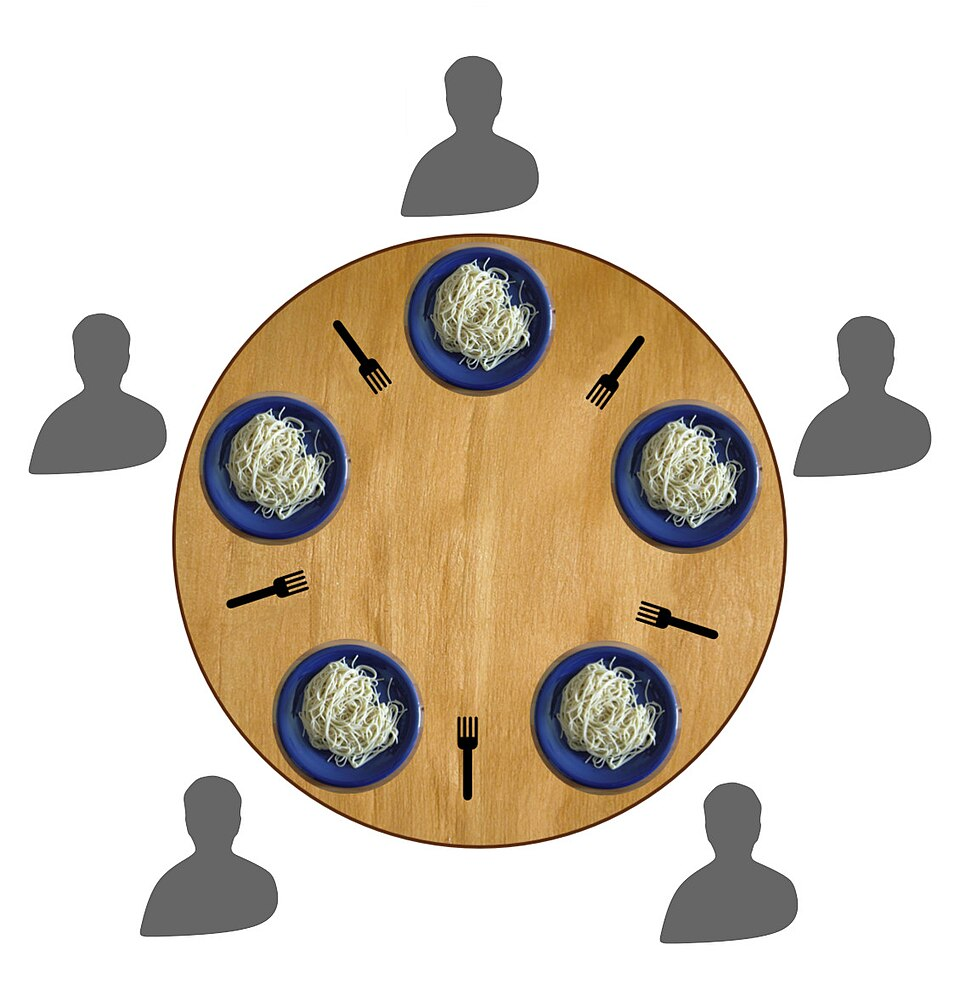
Example of Deadlock: Dining Philosophers
5 philosophers are seated around a table spending their time thinking and eating
Each philosopher has a fork to their left and to their right
In order to eat a philosopher must have both forks in their hands
Synchronization: Programming Mutual Exclusion
Synchronization is the programming construct used to ensure
mutual exclusion in Java.
Two synchronization idioms are used:
Synchronized methods
public synchronized void foo() {
  // ...
}
Only one thread at a time can execute in a synchronized method.
The lock is on the object providing the methods.
Synchronized blocks
public void foo() {
    synchronized(lock) {
        // ...
    }
}
Only the thread possessing the lock can execute in a synchronized block.
Example: Counter
Consider a static Counter which allows two Farmers to keep track of the number
of sheep in the pen.
public class Counter {
    private static int n = 0;
    public static void increment() {
        n++;
    }
    public static void decrement() {
        n--;
    }
    public static void printCount() {
        // print sheep count...
    }
}
public class Farmer implements Runnable {
    @Override
    public void run() {
        // two sheep arrive
        Counter.increment();
        Counter.increment();

        // one sheep leaves
        Counter.decrement();
    }
}
How many sheep are in the pen?
Counter: Console Output
public static void
    main(String[] args) {

    Farmer f1 = new Farmer();
    Thread t1 = new Thread(f1);

    Farmer f2 = new Farmer();
    Thread t2 = new Thread(f2);

    t1.start();
    t2.start();

    Counter.printCount();
}
Output
Run 1 -> 2 sheep in the pen.
Run 2 -> 3 sheep in the pen.
Run 3 -> 2 sheep in the pen.
Run 4 -> 1 sheep in the pen.
We have a race condition.
Access to the critical region (where we manipulate the shared
resource n) should be synchronized.
Counter: Synchronized Methods
In this trivial example, synchronizing access to both methods
eliminates one of the race conditions. What’s the other one?
public class Counter {
    private static int n = 0;

    public static synchronized void increment() {
        n++;
    }

    public static synchronized void decrement() {
        n--;
    }
}
Main: Join On Thread
We also need to join on the threads before counting!
public static void main(String[] args) {
    Farmer f1 = new Farmer();
    Thread t1 = new Thread(f1);

    Farmer f2 = new Farmer();
    Thread t2 = new Thread(f2);

    t1.start();
    t2.start();
    t1.join();
    t2.join();

    Counter.printCount();
}
Output
Run 1 -> 2 sheep in the pen.
Run 2 -> 2 sheep in the pen.
Run 3 -> 2 sheep in the pen.
Run 4 -> 2 sheep in the pen.
No more race condition!
Case Study: Producer/Consumer problem
Consider a queue which buffers data provided by a
Producer and removed by a Consumer
the queue has a maximum size
the Producer should not add to a full queue
the Consumer should not consume from an empty queue
How do we avoid…
putting objects in a full queue?
attempting to remove them from an empty one?
We will explore a solution that implements a singleton queue.
Educational purposes only!
BlockingQueue implementations already exist!
Producer/Consumer: Design Overview
Producer (thread)
integers are placed in the Queue
waits when the Queue is full
Queue – a singleton queue
holds integer values
starts being empty
has a maximum size
Consumer (thread)
waits for a non-empty Queue
consumes its contents
Queue: recall the singleton pattern…
A single instance of Queue is referenced globally by the
Producer and Consumer
thus, we can implement it using the singleton pattern.
Recall that the singleton pattern is not necessarily
thread-safe unless implemented correctly.
lazy vs. eager instantiation
Let’s see why…
Queue: Lazy Instantiation
public class Queue {
    private static final int CAPACITY = 5;
    private List<Integer> dataQueue = new ArrayList<>();
    private static Queue uniqueInstance;

    private Queue() {}

    public static Queue getInstance() {
        if (uniqueInstance == null) {
            uniqueInstance = new Queue();
        }
        return uniqueInstance;
    }

    // enqueue(), dequeue()...
}
Queue: Lazy Instantiation Pitfall
Consider the case in which the Producer and Consumer running
concurrently in separate threads call Queue.getInstance() in order
to access data in the queue…
public static Queue getInstance() {
    if (uniqueInstance == null) {
        uniqueInstance = new Queue();
    }
    return uniqueInstance;
}
If Consumer reaches the if check before Producer has instantiated uniqueInstance
on the assignment line, getInstance() will return two separate, unique instances of Queue!
Queue: Eager Instantiation Fix
public class Queue {
    private static final int CAPACITY = 5;
    private List<Integer> dataQueue = new ArrayList<>();
    private static Queue uniqueInstance = new Queue();

    private Queue() {}

    public static Queue getInstance() {
        return uniqueInstance;
    }

    // enqueue(), dequeue()...
}
uniqueInstance is instantiated eagerly (i.e. before we know
we need it). What is another way of addressing this thread-safety
issue?
Queue: Synchronized getInstance Fix
public class Queue {
    private static final int CAPACITY = 5;
    private List<Integer> dataQueue = new ArrayList<>();
    private static Queue uniqueInstance;

    private Queue() {}

    public static synchronized Queue getInstance() {
        if (uniqueInstance == null) {
        uniqueInstance = new Queue();
        }
        return uniqueInstance;
    }
    // enqueue(), dequeue()...
}
Here, we preserve lazy instantiation but synchronize access
to getInstance(), ensuring that only one thread will be
active in the method at a time.
Producer/Consumer Concept
In this example (and often in practice), Producers and
Consumers are tasks running concurrently in different threads
while exchanging information through a shared data structure.
Their execution is coordinated using synchronized methods
accessed within the Queue object.
Producer
public class Producer implements Runnable {
    @Override
    public void run() {
        Queue queue = Queue.getInstance();

        while (!Thread.interrupted()) {
            Integer newData = new Random().nextInt();
            queue.enqueue(newData);
        }
    }
}
Consumer
public class Consumer implements Runnable {
    @Override
    public void run() {
        Queue queue = Queue.getInstance();

        while (!Thread.interrupted()) {
            // consume the last value in the queue
            queue.dequeue();
        }
    }
}
Producer/Consumer: Guarded Blocks
While the Producer and Consumer wait for the Queue to be in an
appropriate state (non-full or non-empty, respectively), they must
perform guarded blocks.
Guarded blocks allow the execution of threads to be coordinated
based upon the state of shared variables.
There are two types of guarded blocks:
Bad: Busy waiting
Good: Wait/notify
Queue: Guarded block with a busy wait
public class Queue {
    private static final int CAPACITY = 5;
    private List<Integer> dataQueue = new ArrayList<>();
    private static Queue uniqueInstance;

    // constructor, getInstance() ...

    public void enqueue(Integer data) {
        while (dataQueue.size() >= CAPACITY) {
            // wait...
        }
        dataQueue.add(data);
    }
}
Busy waits are a waste of processor resources!
Queue: Guarded block with wait/notify
public class Queue {
    private static final int CAPACITY = 5;
    private List<Integer> dataQueue = new ArrayList<>();
    private static Queue uniqueInstance;

    // constructor, getInstance() ...

    public synchronized void enqueue(Integer data) {
        while (dataQueue.size() >= CAPACITY) {
            try {
                wait();
            } catch (InterruptedException e) {
                e.printStackTrace();
            }
        }
        dataQueue.add(data);
        notifyAll();
    }
}
What’s happening here?
enqueue is synchronized now. wait calls must be
performed by threads currently holding the lock in a synchronized
method or block.
We still have a while loop: wait calls must occur in a
loop. Otherwise, our waiting thread might be asleep when it’s
notified by another thread to wake.
Despite the while loop, our call to
wait signals the thread scheduler to
use processor resources elsewhere
No more busy wait!
Queue: Guarded block on dequeue
public class Queue {
    private static final int CAPACITY = 5;
    private List<Integer> dataQueue = new ArrayList<>();
    private static Queue uniqueInstance;

    // constructor, getInstance(), enqueue()...

    public synchronized Integer dequeue() {
        while (dataQueue.isEmpty()) {
        try {
            wait();
        } catch (InterruptedException e) {
            e.printStackTrace();
        }
        }
        notifyAll();
        return dataQueue.removeLast();
    }
}
Producer/Consumer: Conclusion
Using synchronization idioms, the execution of two different
threads (in this case, Producer and Consumer) can be coordinated.
Is synchronization always necessary?
no, and in some cases it can be a detriment to performance
redundant when applied to threads that possess mutually exclusive, private state