Lecture 20 Object Design Safety and Liveness
Joseph Haugh
University of New Mexico
Software Assurance: Testing
Testing is an integral part of software development
- is a necessity at all levels
- is expensive
- can be simplified through the use of tools
- illuminates the existence of bugs
- fails to establish the absence of bugs
- is assisted by debugging tools and skills
Software Assurance: Testing
Concurrency makes testing exceedingly difficult
- Program A
- 10 boolean variables
- 210 possible states
- Program B
- 10 boolean variables
- 210 possible states
- Concurrent execution
- 210 × 210 possible states
- 210 = 1024
- 220 = 1048576
Software Assurance: Verification
- Formal verification
- provides strong guarantees
- is difficult to carry out
- requires specialized knowledge and tools
- Good design facilitates both testing and verification
Key Concepts in Verification
- Safety: the program does nothing wrong
- data integrity
- absence of deadlock
- Liveness: the program does something
- reaches a desired goal
- terminates
Example: Memory Compaction
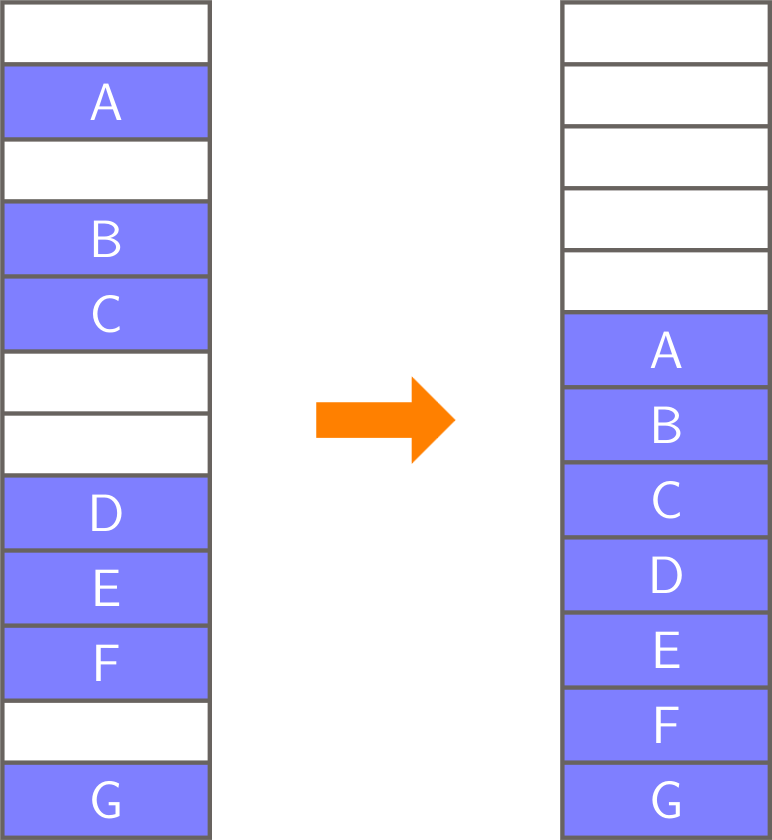
Specification
- Safety
- the contents of each used memory block remains unchanged
- the ordering of used memory blocks remains unaltered
- the number of free space blocks remains unchanged
- Liveness
- the protocol reaches a state in which all free space is contiguously located at the top
Safety Properties
- Invariant: a property that holds initially and forever
- block A holds data XX
- block A is above block C
- Stable: a property which, once established, holds forever
- all blocks below the kth block are used blocks
- all blocks above the kth block are free blocks
Liveness Properties
- Leads to: from a state S1 the Memory Compaction program
eventually reaches a state S2
- S1: any memory state
- S2: all free space is at the top
- Metric: progress is measured by a decrease in some useful metric
- sum of distances from the top of the memory to each free block
- initial value: 0 + 2 + 5 + 6 + 10 = 23
- final value: 0 + 1 + 2 + 3 + 4 = 10
- sum of distances from the top of the memory to each free block
Important Observations
- The protocol may be implemented as a sequential or concurrent program
- Concurrent threads should not interfere with each other
- this is an important additional proof obligation
- the proof may be highly complex
- the program may be vulnerable to subtle errors
- It is desirable to ensure correctness by design
- at least when it comes to non-interference (atomicity)
Design of Safe Objects
- Conservative design strategies
- Immutability: avoiding state changes
- Synchronization: ensuring mutual exclusion
- Containment: structural restrictions ensuring exclusive access
Immutable Objects: Reliance on Constructors
- Fixed variables can be initialized in the constructor
- No methods to change the variable are provided
public class Leader {
  private final NodeId n;

  public Leader(NodeId n) {
    this.n = n;
  }
  // no setter for field!
}
Immutable Objects: Stateless Methods
- Methods that have no bearing on the state of the object
- Pure functions
- return value depends only on the passed arguments
- return value may also depend upon immutable variables
public class NumericalOps {
  public static int add(int a,
                        int b) {
    return a + b;
  }
}
public class Leader {
private final NodeId n;
//...
public int rank(NodeId k) {
if (k.id() < n.id()) {
return n.id() - k.id();
} else {
return 0;
}
}
}Immutable Objects: Copying Policy
- Making a local temporary copy and returning it as the result of the computation protects the original object
- Copy needs to be atomic in order to avoid destroying data integrity
- The object passed as argument needs to offer an atomic copy method
public int[] sort(int[] array) {
  int[] copy = new int[array.length];
  // place sorted elements in copy...
  return copy;
}
Immutable Objects: Records
Java records are a compact way to declare immutable data carriers.
Regular immutable class
public class Leader {
  private final NodeId n;
  public Leader(NodeId n) {
    this.n = n;
  }
  public NodeId n() { return n; }
  @Override
  public boolean equals(Object o) { ... }
  @Override
  public int hashCode() { ... }
  @Override
  public String toString() { ... }
}
As a record
public record Leader(NodeId n) { }The compiler generates all of the boilerplate automatically.
Immutable Objects: What Records Provide
For each component declared in the header the compiler generates:
- A
private finalfield - A public accessor method named after the component (no
getprefix) - A canonical constructor that initializes all fields
equals(),hashCode(), andtoString()derived from all components
Leader a = new Leader(someNode);
Leader b = new Leader(someNode);

a.n();          // accessor, note: not getName()
a.equals(b);    // true if all components are equal
a.toString();   // "Leader[n=...]"
Immutable Objects: Record Limitations
- Implicitly final: records cannot be extended, and cannot extend other classes
- they may implement interfaces
- No additional instance fields: only the components in the header
- All fields are final: no setters, no mutable state
// OK: validation in a compact constructor
public record Leader(NodeId n) {
  public Leader {
    if (n == null) throw new IllegalArgumentException();
  }
}
// NOT OK: adding instance state
public record Leader(NodeId n) {
  private int cache; // compile error!
}
Synchronized Objects: Full Synchronization
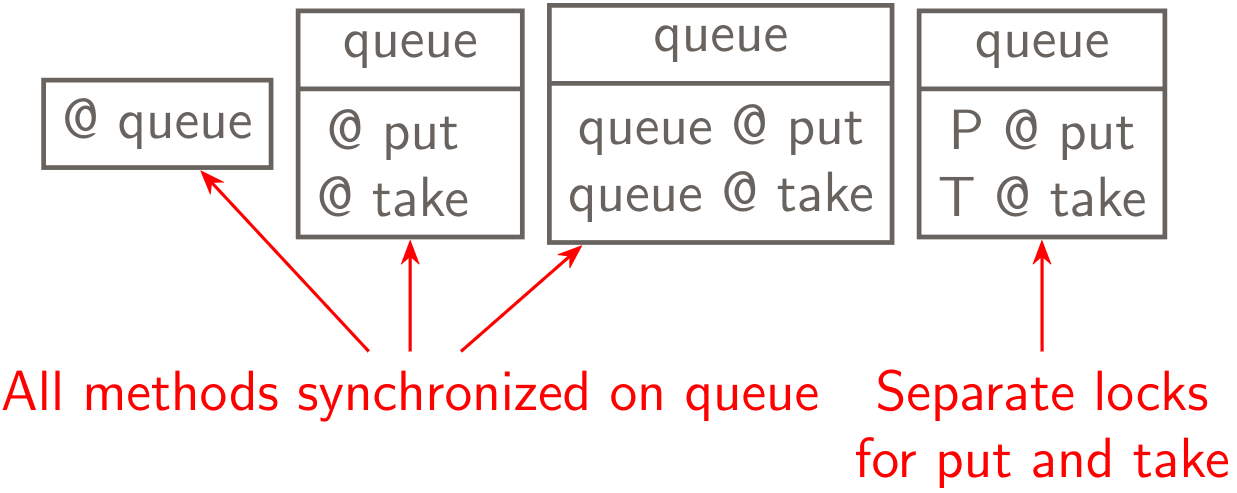
- The goal is to ensure mutual exclusion among all the methods
accessing the object
- every method is synchronized
- no public fields are present
- Access to other objects can break encapsulation!
- Careful analysis and discipline is required
Display Room Lighting
- Assume that we have a display room with multiple light sources
- one and only one light is on at any one time
- a user can select a light to turn on
- a user can turn off the light, forcing some other light to be turned on
Synchronized Object: Display Room Lighting
public class LightControl {
  private List<Light> lights;
  private Light onLight;
  private Random rand;
  // initialize fields...

  public synchronized void on(Light light) {
    if (onLight != null) onLight.turnOff();
    onLight = light;
    onLight.turnOn();
  }

  public synchronized void off() {
    if (onLight != null) onLight.turnOff();
    onLight = lights.get(rand.nextInt(lights.size()));
    onLight.turnOn();
  }
}
Static Field Complications
- Synchronization assures mutual exclusion among methods of the same object
- Methods of different objects can interfere with each other if they access static fields
- Options:
- allow only static synchronized methods to access static fields
- use block synchronization with a lock on that class:
getClass()
Protecting Static Fields: File Users Counter
public class FileUsers {
  private static int userCount = 0; // never access directly

  protected void beginUsing() {
    synchronized (getClass()) {
      ++userCount;
    }
  }

  protected void endUsing() {
    synchronized (getClass()) {
      --userCount;
    }
  }

  public static synchronized int numberUsing() {
    return userCount;
  }
}
Partial Synchronization
- Only methods that can interfere with each other are declared as synchronized
- Only sections of code where interference can occur are protected by a synchronization block
synchronized(this) {
  // code here...
}
Partial Synchronization: Linked List
public class LinkedCell {
  protected double value;
  protected final LinkedCell next;

  public LinkedCell(double value, LinkedCell next) {
    this.value = value;
    this.next = next;
  }

  public synchronized double getValue() { return value; }

  public synchronized void setValue(double value) {
    this.value = value;
  }

  public LinkedCell getNext() { return next; }
  // add up element values
  public double sum() {
    double v = getValue(); // get value via synchronized accessor
    if (next() != null) { v += next().sum(); }
    return v;
  }
}value, setValue, and sum share access to value, access must be synchronized!
Contained Objects: Exclusive Ownership
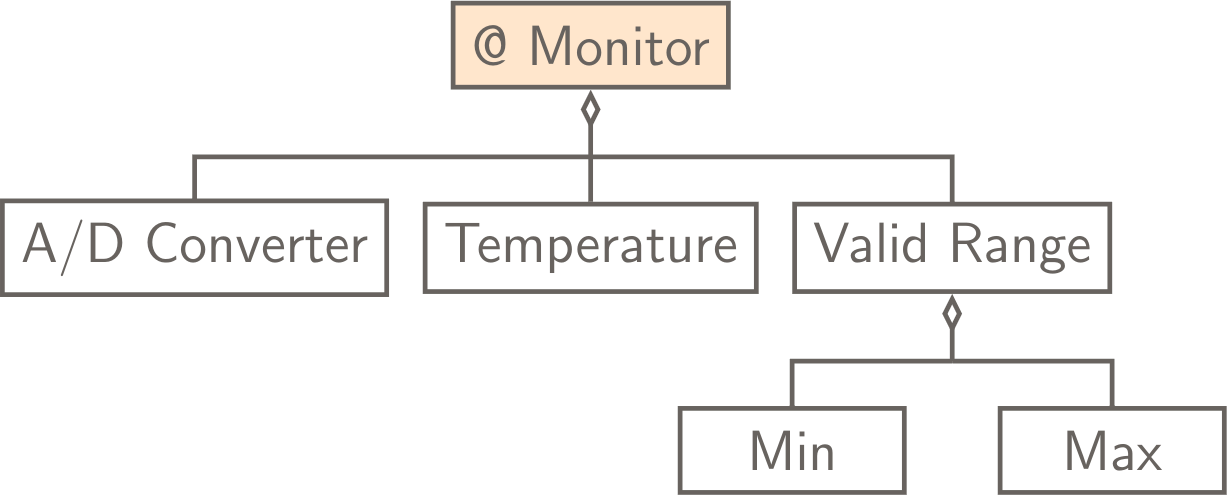
- The outer object
- ensures that only one thread executes at a time (synchronized methods)
- subordinate objects are locally created
- references to the subordinate objects are not leaked
- not passed as arguments
- not passed as returned values
Exclusive Ownership Example
Contained Objects: Managed Ownership
- It is often the case that ownership of a resource may change over time
- Invariant: only one accessible reference exists in the system at any one time
- Ownership transfer operations must be subject to defined policies enforced by design
Liveness: Failure Modes
- Reliance on timing properties
- proofs of concurrent programs are meant to show that under all possible interleaving of events the execution is correct
- Contention on the CPU leading to starvation
- proofs of concurrent programs assume that no thread is denied service by the OS
- Dormancy: a suspended thread never becomes schedulable again
- suspend/resume and wait/notify pairing errors
- Premature termination
- Deadlock
Deadlock Prevention
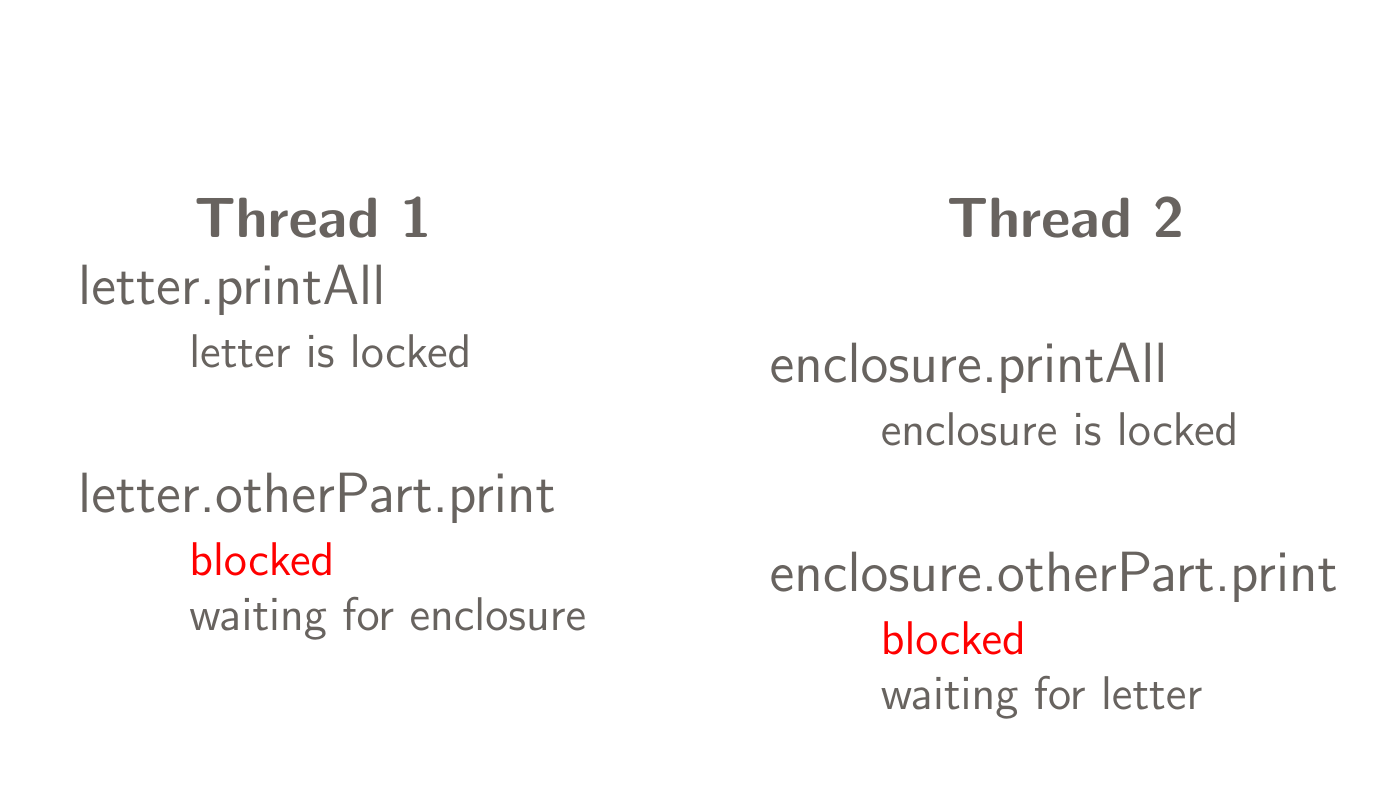
- Every thread locks the resources it needs in the same order
- The locking order is not always readily visible
- Complications arise when locks are deep inside the object nesting structure
public class Document {
  private Document otherPart;
  public synchronized void print() {
    // print this part of the document
  }
  public synchronized void printAll() {
    otherPart.print();
    print();
  }
}
Deadlock Illustration

Deadlock Illustration

Deadlock Illustration
Additional Failure Modes
- Data integrity violations
- synchronized methods do not always guarantee atomicity
- data inconsistencies lead to incorrect decisions
- Lack of progress
- progress made by one thread is undone by another
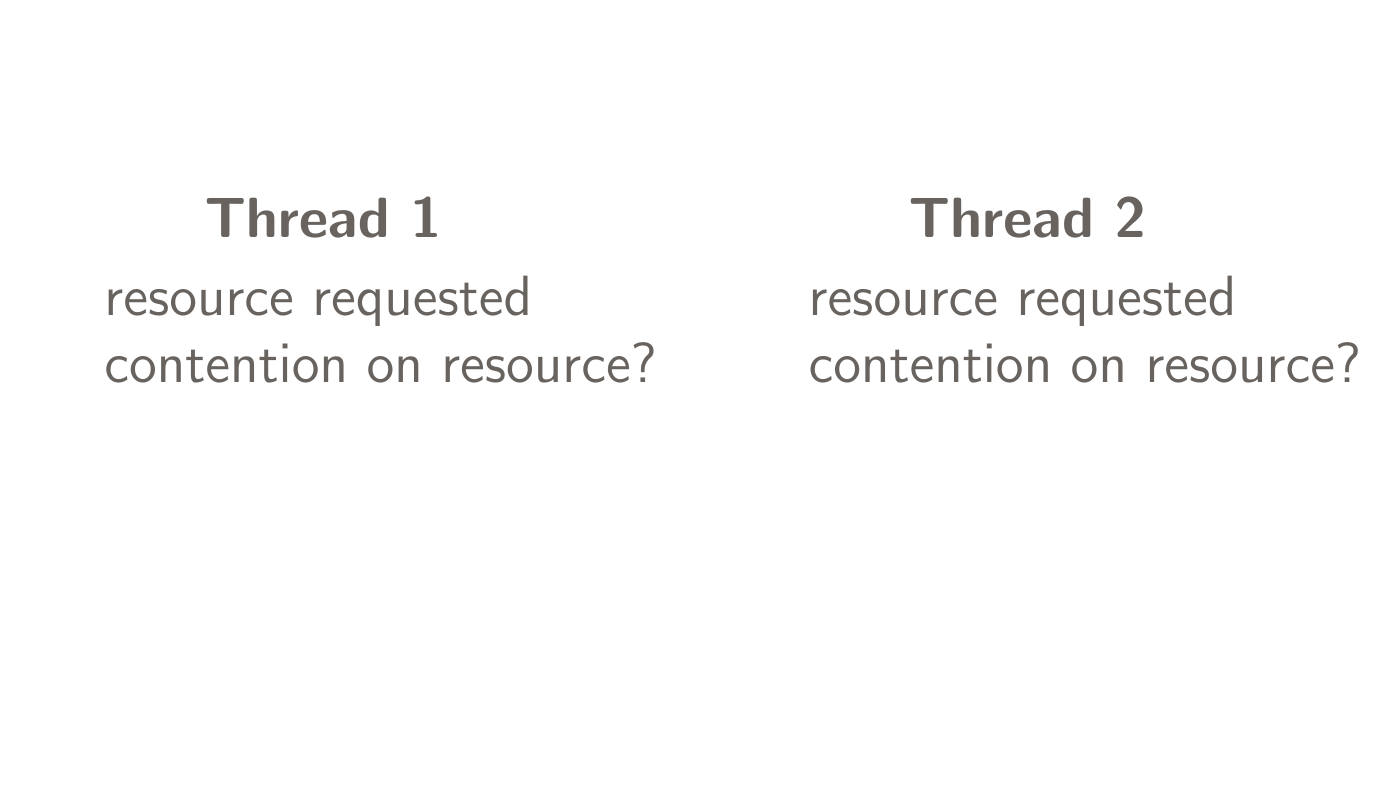
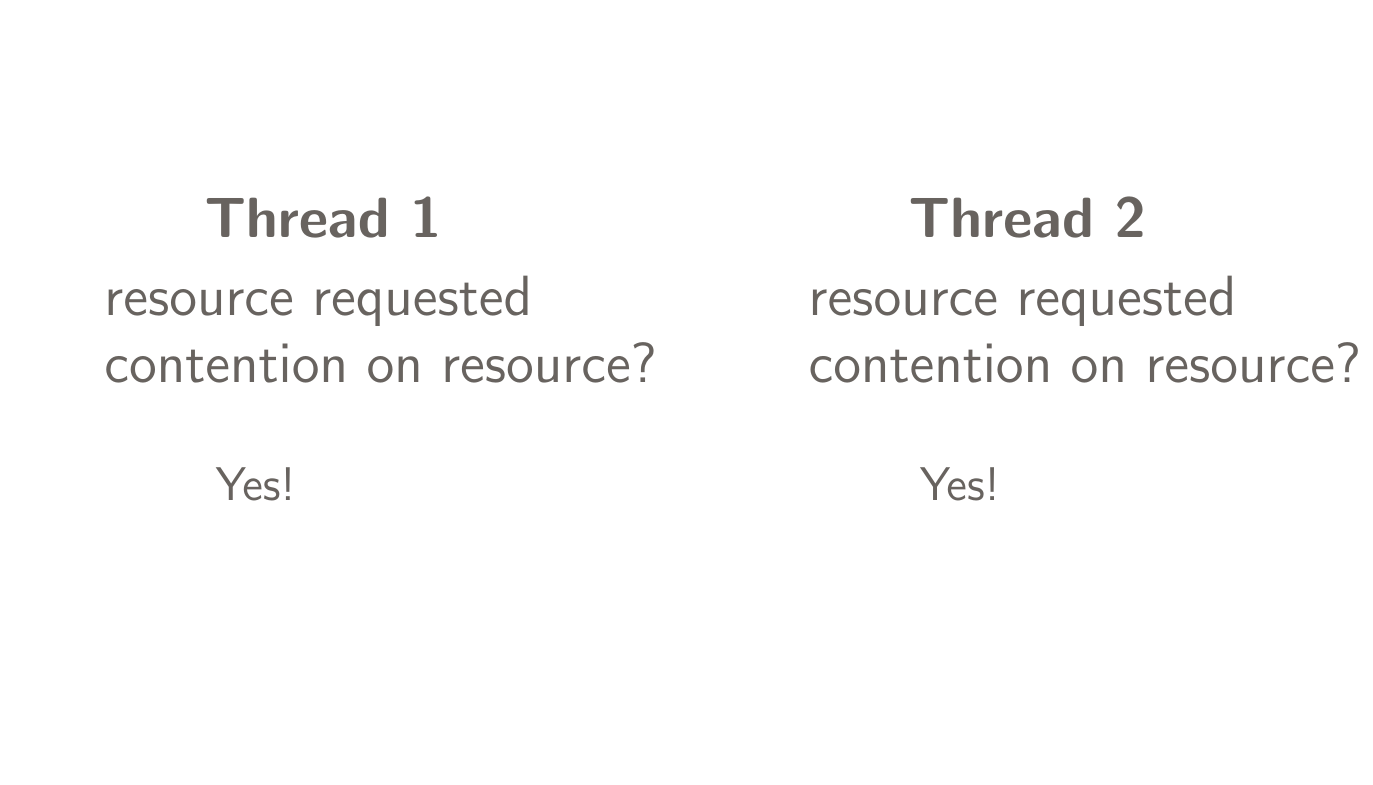
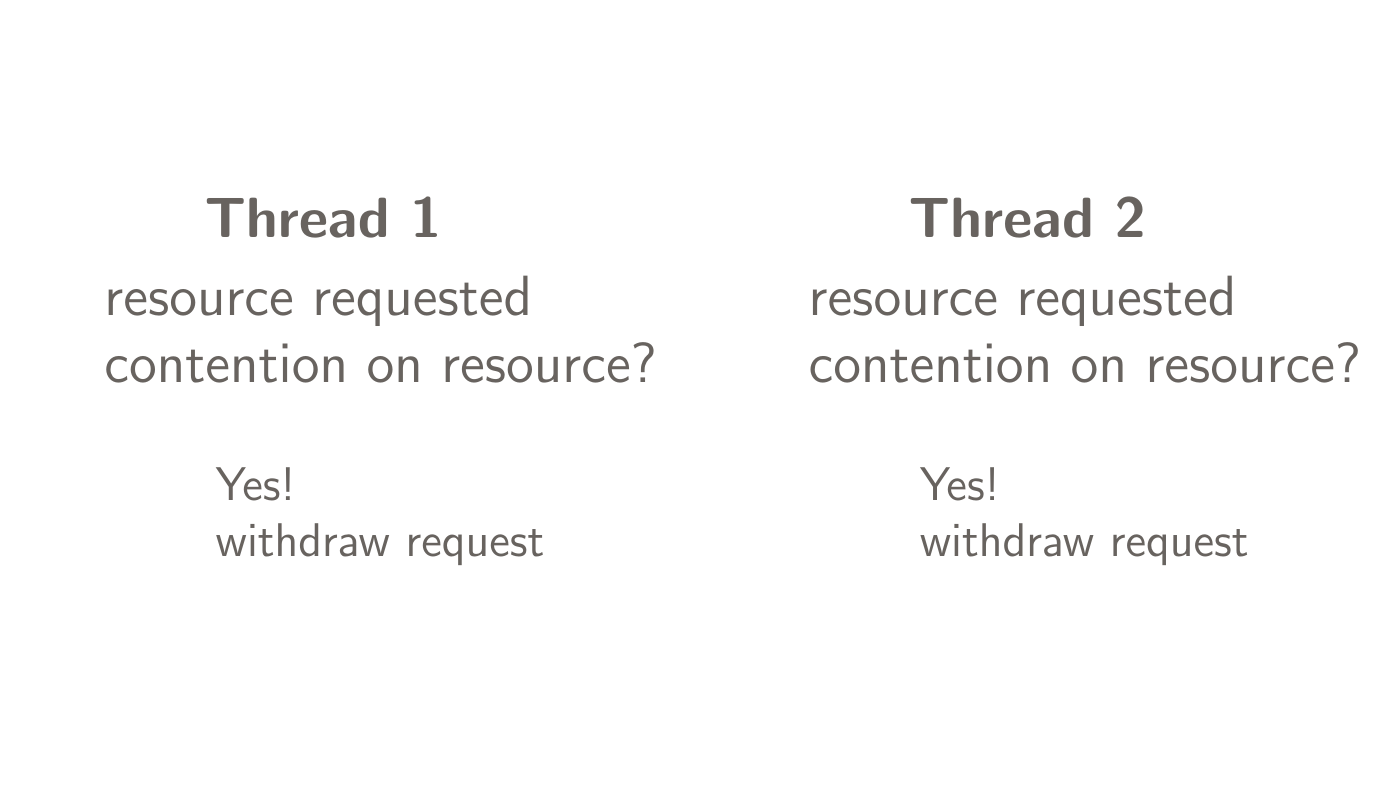
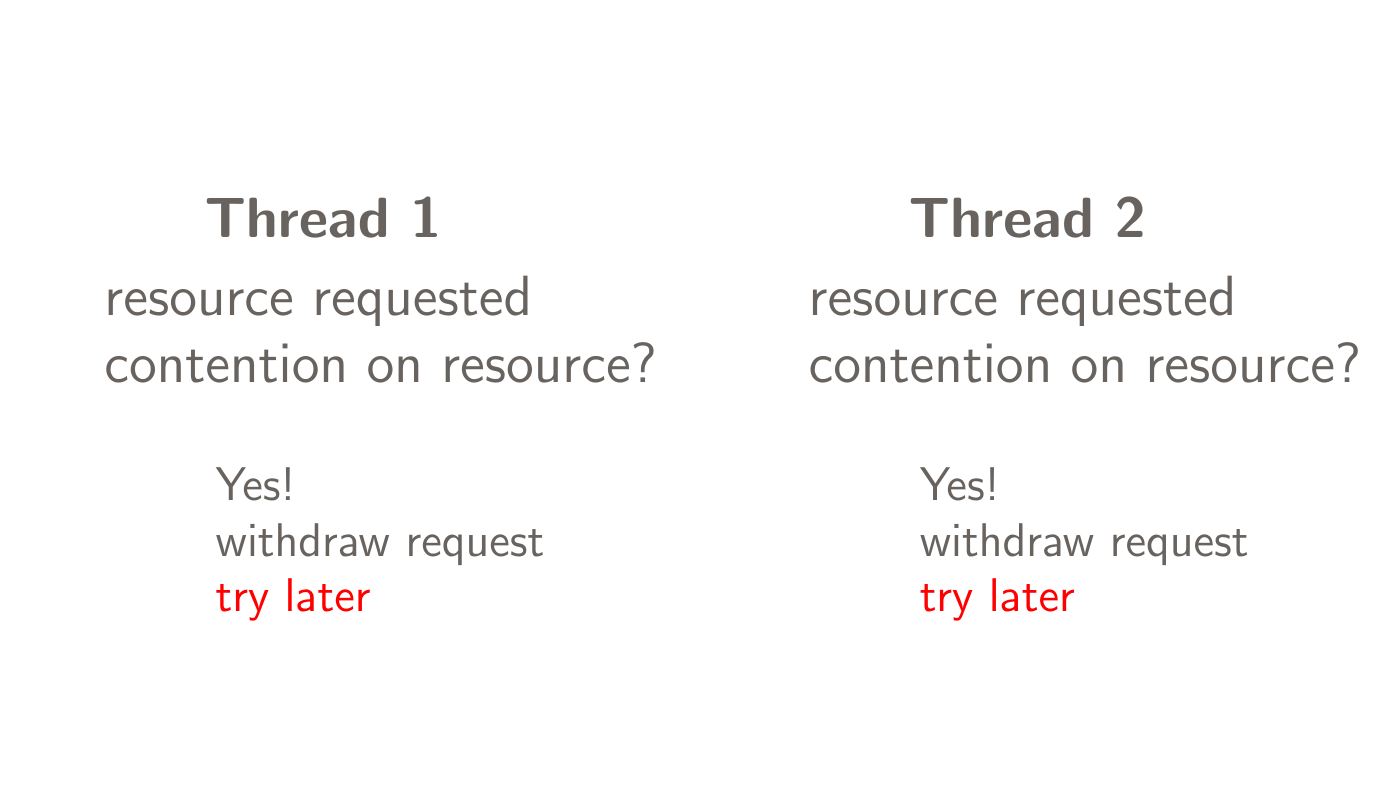
- Livelock
- threads take turns yielding to each other
Livelock Illustration

Livelock Illustration
Livelock Illustration
Livelock Illustration
Livelock Illustration
How could we stop colliding?
Locking and Performance
- Synchronized methods and locks may introduce performance penalties
- correctness must come first
- thoughtful analysis can ensure correctness and enhance performance
- Instance variable analysis helps determine where synchronization is or is not needed
- Proper design of object hierarchies may simplify analysis and reduce the need for synchronization
Interleaving Semantics
- Access and update methods are normally synchronized
- A very long update can delay reading of the data
- Two solutions:
- employ synchronization blocks
- let the access method be un-synchronized as long as it
returns one of only two values:
- the value before the update
- the value after the update
A Conservative Design Revisited
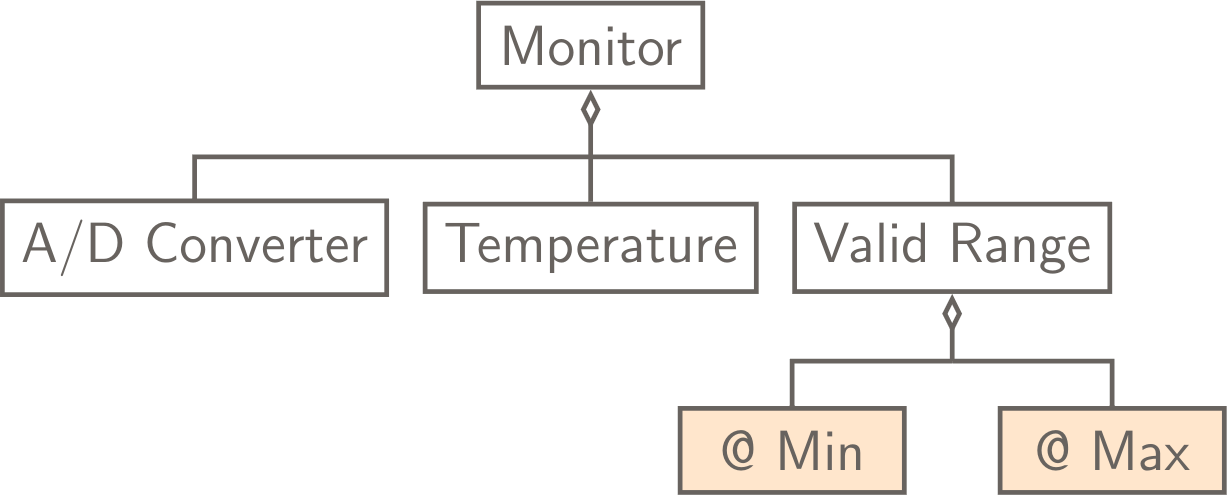
- All methods of Monitor are synchronized
- protection against any data inconsistencies
- Only one thread can use Monitor at a time
Class Splitting
- Monitor can be redesigned
- by using synchronization only on contained objects that need it
- Multiple threads can use Monitor concurrently
- More generally, contained objects may be designed in order to achieve fine-grained synchronization and increased levels of concurrency
Class Splitting
Lock Splitting
- Every Java Object can be a lock
- Synchronized methods use the object to which they belong as a lock
- Another object could be used to accomplish the same objective
- Using multiple locks allows subgroups of methods to be mutually exclusive
- Going one step further, locks can be selectively used in a state dependent manner
Sample Design Notation
Sample Design Notation