Lecture 21 Concurrency Control
Joseph Haugh
University of New Mexico
Concurrency Control Definition
- Layering of synchronization and control policies over base mechanisms
- Key assumption: ground classes have been designed to be amenable to the desired forms of control
- Strategies
- adding policy control in subclasses
- controlling delegated actions
- representing messages as objects
Adding Synchronization Via Subclassing
- Ground level class
- provides non-public methods
- enforces no invariants
- Subclass
- implements the synchronization policy, e.g.,
- atomic updates
- bounded counter
- delegates actions to ground methods
- implements the synchronization policy, e.g.,

Bounded Counter Code
public class GroundCounter {
  protected long count;

  protected GroundCounter(long c) {
    count = c;
  }

  protected long value() { return count; }

  protected void inc() {
    ++count;
  }

  protected void dec() {
    --count;
  }
}
Bounded Counter Code
public class BoundedCounter extends GroundCounter {
  private final long MIN, MAX;

  public BoundedCounter(final long MIN, final long MAX) {
    super(MIN);
    this.MIN = MIN;
    this.MAX = MAX;
  }

  public synchronized long value() { return super.value(); }

  public synchronized void inc() {
    while (value() >= MAX) {
      try { wait(); } catch(InterruptedException e) {};
    }
    super.inc();
    notifyAll();
  }

  public synchronized void dec() {
    while (value() <= MIN) {
      try { wait(); } catch(InterruptedException e) {};
    }
    super.dec();
    notifyAll();
  }
}
Anomalies to be Avoided
If all relevant variables and methods are declared protected the subclass can generally implement the desired policy
- Frequent problems
- failing to track all conditions on which the subclass depends
- differences in state representation
- immutable variable in the superclass is being modified
- introducing waits for which the subclass has no matching notifications
- extensions which require a transition from
notifytonotifyAll
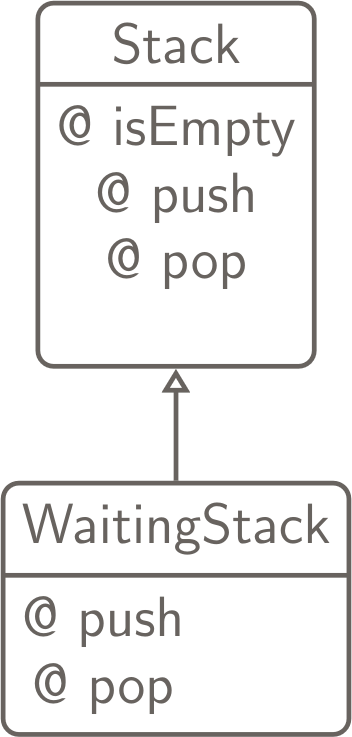
Layering Guards
- Ground level class
- ensures atomicity
- generates exception on empty stack
- forces a busy wait solution in a concurrent setting
- Subclass
- eliminates the exception generation
- adopts a wait/notify protocol
- delegates select actions to ground methods
Waiting Stack Code
public class Stack {
  public synchronized boolean isEmpty() {
    // ...
  }
  public synchronized void push(Object x) {
    // ...
  }
  public synchronized Object pop() throws StackEmptyException {

    if (isEmpty()) {
      throw new StackEmptyException();
    } else {
      // ...
    }
  }
}
Waiting Stack Code
public class WaitingStack extends Stack {
  public synchronized void push(Object x) {
    super.push(x);
    notifyAll();
  }

  public synchronized Object pop() throws StackEmptyException {
    while(isEmpty()) {
      try {
        wait();
      } catch (InterruptedException e) {}
    }
    return super.pop();
  }
}
Conflict Sets and Others
- Design paradigm
- track the superclass state through the introduction of auxiliary variables
- block method calls based on the current abstract state of the superclass
- Sample formalizations
- conflict set
- conflict graph
- finite set control
Conflict Set
A conflict set is a list of pairs of operations that cannot run concurrently
- Each pair (m1, m2) means: if m1 is executing, m2 must wait (and vice versa)
- If a pair is absent, the two operations may run simultaneously
- Example: Inventory
- (store, retrieve): a store and a retrieve cannot overlap
- (retrieve, retrieve): two retrieves cannot overlap
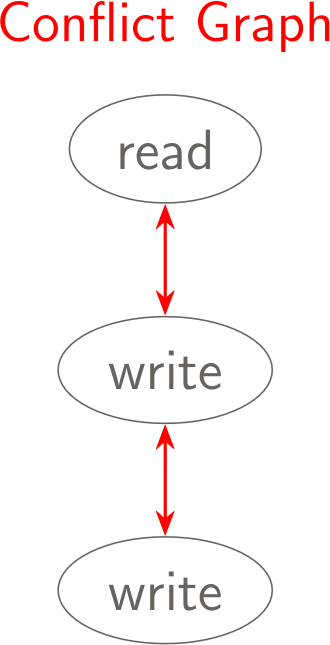
Conflict Graph
A conflict graph is a visual equivalent of the conflict set
- Each node is an operation
- A double-headed arrow between two nodes means they conflict
- If no arrow exists between two nodes, they may run concurrently
The conflict graph makes it easy to see at a glance which operations are mutually exclusive and which can be parallelized
Finite State Control
Finite state control describes how the policy is enforced at runtime using a state machine
- Each state represents the current abstract state of the object (e.g., how many readers or writers are active)
- Arrows show transitions triggered by operation entry and return
- Entry arrows (left side): a thread requests to begin an operation
- it may block until the state allows it
- Return arrows (right side): a thread finishes and updates state, potentially unblocking waiters
This maps directly to the synchronized blocks that bracket
each operation in the implementation
Illustration: Inventory Control

Illustration: Inventory Code
public class Inventory extends GroundInventory {
  protected int storing = 0;
  protected int retrieving = 0;

  public void store(String desc, Object item,
                    String supplier) {
    synchronized (this) {
      while (retrieving != 0) {
        try { wait(); } catch (InterruptedException e) {}
      }
      ++storing;
    }

    super.store(desc, item, supplier);

    synchronized (this) {
      if (--storing == 0) {
        notifyAll();
      }
    }
  }
Illustration: Inventory Code
  public void retrieve(String desc, Object item,
                       String supplier) {
    synchronized (this) {
      while (storing != 0 || retrieving != 0) {
        try { wait(); } catch (InterruptedException e) {}
      }
      ++retrieving;
    }

    super.retrieve(desc, item, supplier);

    synchronized (this) {
      if (--retrieving == 0) {
        notifyAll();
      }
    }
  }
Readers and Writers: A Common Design Pattern
- A simple conflict graph
- Readily ensured safety
- Major variations when it comes to liveness and lack of starvation
General Pattern
- Track the number of waiting and active readers and writers
- Bracket the read/write operations with before/after control code
- Same design accommodates a wide range of policies
General Pattern Code
public abstract class ReadWrite {
  protected int activeReaders = 0;
  protected int activeWriters = 0;
  protected int waitingReaders = 0;
  protected int waitingWriters = 0;

  protected abstract void doRead();
  protected abstract void doWrite();

  public void read() {
    beforeRead();
    doRead();
    afterRead();
  }

  public void write() {
    beforeWrite();
    doWrite();
    afterWrite();
  }
Control Code: before/afterRead
protected synchronized void beforeRead() {
  ++waitingReaders;
  while (!allowReader()) {
    try { wait(); } catch (InterruptedException e) {}
  }
  --waitingReaders;
  ++activeReaders;
}

protected synchronized void afterRead() {
  --activeReaders;
  notifyAll();
}
Control Code: before/afterWrite
protected synchronized void beforeWrite() {
  ++waitingWriters;
  while (!allowWriter()) {
    try { wait(); } catch (InterruptedException e) {}
  }
  --waitingWriters;
  ++activeWriters;
}

protected synchronized void afterWrite() {
  --activeWriters;
  notifyAll();
}
Policy: Reading Priority
- Direct enforcement of the conflict set rules
- readers can read unless a writer is writing
- a writer can start writing if no other thread is reading or writing
- Writers can be starved if readers continue to use the resource
protected boolean allowReader() {
  return activeWriters == 0;
}

protected boolean allowWriter() {
  return activeReaders == 0 && activeWriters == 0;
}
Policy: Reading Preemption
- Writer starvation is prevented by blocking new reading threads once a writer is waiting
- Readers can be kept out by multiple writers waiting in line
protected boolean allowReader() {
  return waitingWriters == 0 && activeWriters == 0;
}

protected boolean allowWriter() {
  return activeReaders == 0 && activeWriters == 0;
}
Policy: Turn Taking
- If both readers and writers are waiting, alternate between readers and writers
- Still, there is no guarantee that no readers or writers are blocked forever
Policy: Turn Taking
private boolean canWrite;

public synchronized void afterRead() {
  canWrite = true; // ...previous afterRead code...
}
public synchronized void afterWrite() {
  canWrite = false; // ...previous afterWrite code...
}

protected boolean allowReader() {
  if (waitingWriters > 0 && waitingReaders > 0) {
    return !canWrite && activeWriters == 0;
  }
  return waitingWriters == 0 && activeWriters == 0;
}

protected boolean allowWriter() {
  if (waitingWriters > 0 && waitingReaders > 0) {
    return canWrite && activeWriters == 0;
  }
  return activeReaders == 0 && activeWriters == 0;
}
Policy: Custom Scheduler
- Each reader/writer makes a request and gets a ticket number
- Each request and its type (read/write) is placed in a queue according with some policy that optimizes throughput and ensures fairness
- A writer starts working when its ticket is first in the queue
- A reader starts working when its ticket is part of a sequence of read requests at the front of the queue
- Tickets are returned upon completion of the operation
- Ticket counter is reset when no tickets are out
Basic Adapter Concept
- An adapter is a specialized wrapper that offers a new interface based on an existing class
- The main advantages are
- flexibility
- a range of services based on an existing class
- dynamic changes of the base class in use
- reduced coding effort
- reuse of legacy code
- flexibility
- Adapters do not have access to
protected fields and methods
- this is distinct from subclassing
Example: Adapter
Suppose a legacy class measures temperature in Fahrenheit:
public class FSensor {
  public double getTemp() {
    /* returns degrees F */
  }
}
An adapter wraps it to provide a Celsius interface:
public class CSensor {
  private FSensor sensor;
  public CSensor(FSensor sensor) {
    this.sensor = sensor;
  }
  public double getTemperature() {
    return (sensor.getTemp() - 32) * 5.0 / 9.0;
  }
}CelsiusSensorhas no access toFahrenheitSensor’s internals- The client only sees
getTemperature()in Celsius - The legacy class is reused without modification
Example: Rocket
- Internal state
- location (point in 3D space, meters)
- velocity (3D vector, meters/sec)
- flight time (seconds)
- Methods
- read/update location
- read/update velocity
- increment flight time
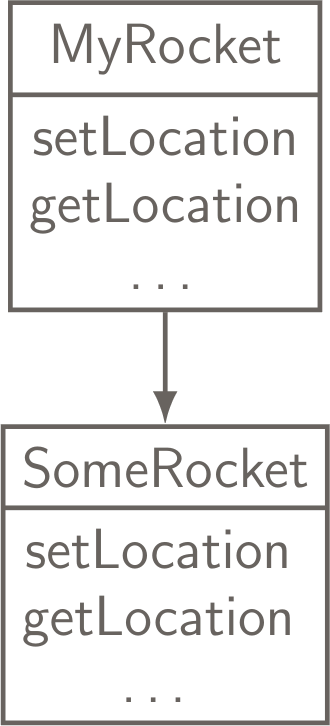
Delegation
The interface is the same as that of the ground class
- actions are simply redirected
- returned values are passed up
- What is the gain?
- flexibility
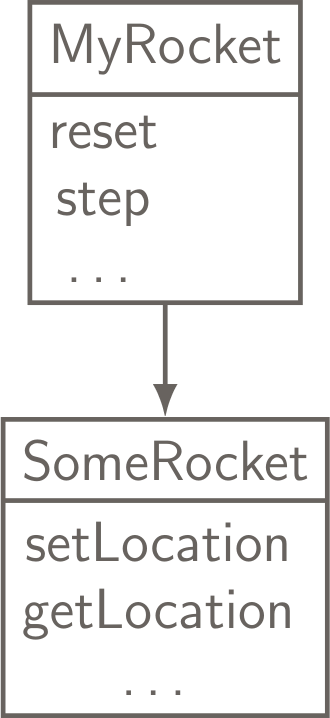
Refactoring
Different methods are provided and coded in terms of the ground class
public void reset() {
  setFlightTime(0);
  setLocation(new PosPoint());
  setVelocity(new VelVec());
}

public void step(VelVec vel) {
  flightTime++;
  velocity = vel;
  location.add(velocity);
}
Superposition
Superposition: a process by which variables are introduced to monitor the state of the ground class
- to extend functionality without actually affecting the state
- to facilitate reasoning about the computation
public void step(VelVec vel) {
  flightTime++;
  velocity = vel;
  location.add(velocity);
  if(velocity.compare(MAX_SAFE_VEL) > 0) {
    unsafeCount++;
  }
}
Proxy: A Useful Design Pattern
- Proxy: an object that stands in place of another
- displays an appropriate veneer
- delegates all actions
- The original object may be a
- concrete object: present in the system and having the same interface
- abstract object: the result of refactoring
Illustration: Proxy Examples

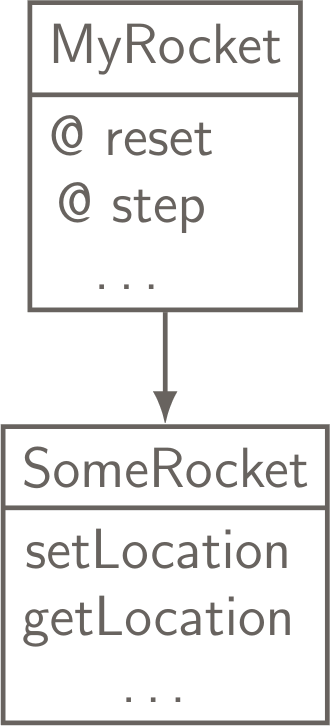
Synchronized Adapters
- In the presence of concurrency, objects designed to function in a single threaded environment need to be protected
- The wrapper can provide the needed synchronization (when the ground object is private)
Synchronized Adapters with Access Control
- An adapter can also introduce blocking of threads in a way that is sensitive to the state of the ground object
- Illustration: block thread waiting for a specific target
velocity to be reached and release it when
- a reset has been issued (return false)
- the target velocity has been reached or exceeded (return true)
Synchronized Adapters with Access Control
public synchronized void step(VelVec vel) {
  // ...
  notifyAll();
}

public synchronized void reset() {
  // ...
  notifyAll();
}

public synchronized boolean targetVelocity(VelVec vel) {
  // mag returns integer magnitude of vector
  while (mag(velocity) != 0 && mag(velocity) < mag(vel)) {
    try { wait(); } catch (InterruptedException e) { }
  }
  if(mag(velocity) == 0) return false; // reset issued
  else return true; // target velocity reached
}
What’s Wrong?
notifyAll wakes waiting threads, but they do not resume immediately,
each must re-acquire the lock before continuing
- Other synchronized methods can acquire the lock first
- By the time the waiting thread resumes, shared state may have changed
What’s Wrong?
- The race:
resetsets velocity to 0 and callsnotifyAll- Before
targetVelocitycan re-acquire the lock,stepruns and sets velocity to a nonzero value targetVelocityfinally resumes and checksmag(velocity) == 0, but it is no longer 0, so it incorrectly returnstrue
- The bug:
- checking
velocityafter waking up does not reliably tell you why you woke up
- checking
Synchronized Adapters with Access Control
public synchronized void step(VelVec vel) {
  // ...
  notifyAll();
}

public synchronized void reset() {
  // ...
  tracking = false;
  notifyAll();
}

public synchronized boolean targetVelocity(VelVec vel) {
  tracking = true; // remains true unless reset
  while (tracking && mag(velocity) < mag(vel)) {
    try { wait(); } catch (InterruptedException e) { }
  }
  if(!tracking) return false;
  tracking = false;
  return true;
}
Extending Atomicity
- An adapter can augment existing methods with additional functionality while making the entire operation atomic
- Illustration: augment the step method to include a logging action
public synchronized void step(VelVec vel) {
  flightTime++;
  velocity = vel;
  location.add(velocity);
  Log.addEntry(flightTime, location);
}

class Log {
  public static synchronized void addEntry(int time,
                                           PosPoint loc) {
    // store/print entry...
  }
}
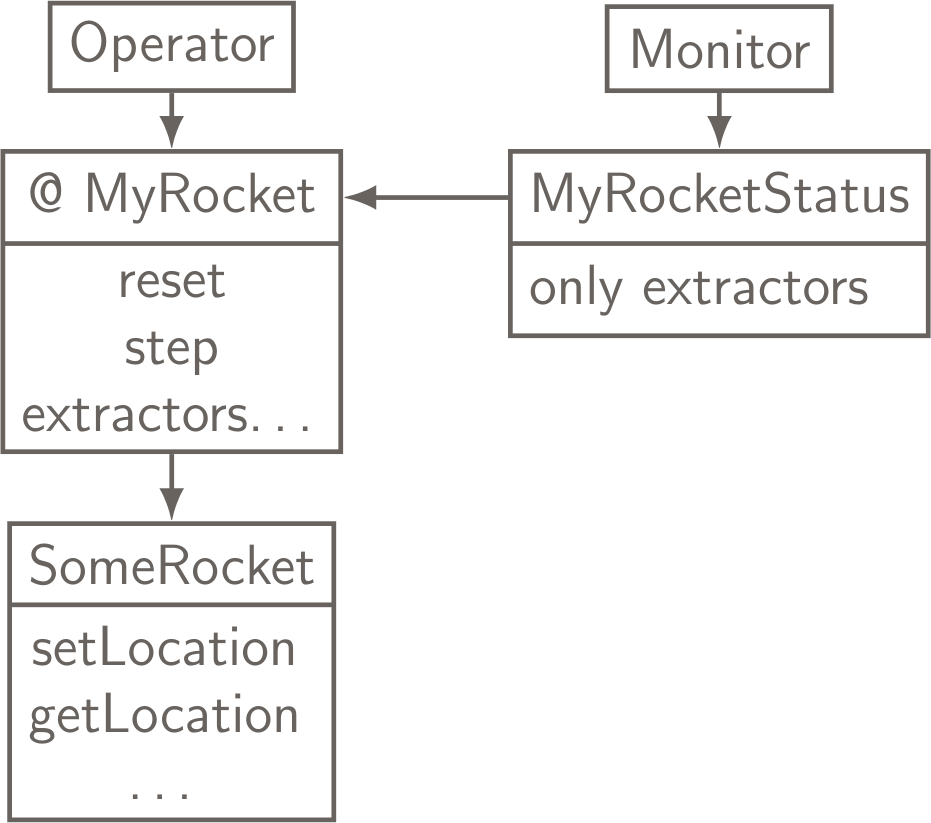
Read Only Adapters
- It is often the case that data needs to be protected against unauthorized modification
- A read-only wrapper gives full access to the object data without the risk of being modified
Read Only Adapters
Programming Concerns
- The methods of the immutable object should be declared final
- The base object B should not be leaked to users of the immutable object X