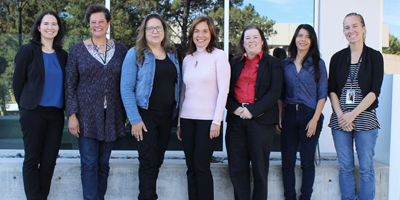
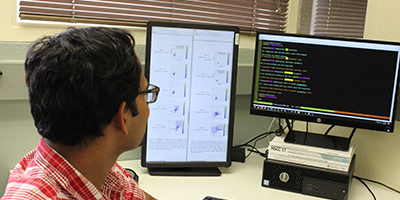
Diane uses machine learning to discover patterns of network activity in brain imaging data from people with varied backgrounds such as mental illness. These functional brain networks tell us how individual areas of the brain interact with each other. Functional networks are similar but not identical from person to person, and we would like to understand how mental illness and treatment affect the brain network. She presented her work "Learning Smoothly Varying Bayesian Network Structures Under Similar Contexts" at the
Snowbird Learning Workshop in April 2010. Diane's advisor is Professor Terran Lane.
In a study titled,
"The Velocity of Censorship: High-Fidelity Detection of
Microblog Post Deletions," currently undergoing peer-review, UNM Assistant
Professor of Computer Science Jed Crandall and Rice University Professor of
Computer Science and Electrical Engineering Dan Wallach in conjunction with an
independent researcher and an undergraduate researcher from Bowdoin College,
describe the staggering speed and efficiency of censorship at Sina Weibo, a
Chinese website similar to Twitter. In February 2012 Weibo had more than 300
million users and about 100 million messages that were sent daily; like Twitter,
Weibo limits message length to 140 characters. In spite of the tremendous
volume, the company can detect a censorship event within one minute of posting.
According to Crandall, "There have been some studies on Weibo showing that
posts are deleted after a day or two, but we see posts being deleted after five
or ten minutes. Basically we showed that if you want to have a complete picture
of internet censorship you have to have something that can measure very quickly
on the order of minutes, and you have to be able to measure a wide variety of
things." The researcher's web crawler searched for posts that appear, and then are
subsequently deleted. Their data showed that five percent of the deletions
happened in the first eight minutes and within 30 minutes nearly 30 percent of
the deletions were completed. More than 90 percent of the deletions occurred
within one day after a post appeared. They calculated it would take 4,200
workers reading 50 posts a minute in eight hour shifts to censor using only
human review of the posts. That led the researchers to the conclusion that much
of the filtering must be automated, through initial flagging and retrospective
searches.
Related links: "The Velocity of Censorship" paper, UNM Today, Jed Crandall.
The ACM (Association for Computing Machinery) recently presented five
prestigious awards for innovations in computing technology and significant
contributions to computer science. UNM Computer Science professor Dr. Stephanie
Forrest was selected for the Newell Award in recognition of her fundamental,
paradigm-changing contributions to computer science and biology. The Newell
Award recognizes an individual for career contributions that have breadth within
computer science, or that bridge computer science and other disciplines. The ACM
cited Dr. Forrest's work developing artificial immune systems for computers and
networks that simulate the behavior of natural immune systems. This work
resulted in new approaches to human vaccine design and improved understanding of
viral dynamics. Her research has also lead to advances in automatic software
fault correction, software (re)generation, and automated diversity for attack
and flaw avoidance. The ACM presented these and other awards at the ACM Awards
Banquet on June 16 in San Francisco, CA. The Newell Award is accompanied by a
prize of $10,000, and is supported by the Association for the Advancement of
Artificial Intelligence, and by individual contributions. Congratulations Dr.
Forrest!
Related links: Association for Computing Machinery (ACM) Award Winners, ACM Newell Award, Stephanie Forrest.
The Computer Science community extends a warm welcome to new Department Chair Michalis Faloutsos. Dr. Faloutsos will become the new Computer Science Department Chair effective January 1, 2013. Michalis Faloutsos is currently a faculty member at the Computer Science Department at the University of California, Riverside. He received his bachelor's degree at the National Technical University of Athens and his M.Sc and Ph.D. at the University of
Toronto. His research interests include Internet protocols and measurements, peer-to-peer networks, network
security, BGP routing, and ad-hoc networks. With his two brothers, he co-authored a paper on power-laws of the
Internet topology, which received the ACM SIGCOMM Test of Time award. His work has been supported by many NSF and military grants, for a cumulative total of more than $6 million. Several recent works have been widely cited in
popular printed and electronic press such as slashdot, ACM Electronic News, USA Today, and Wired. Most recently he
has focused on the classification of traffic and web-security, and co-founded a cyber-security company founded in
2008, offering services as www.stopthehacker.com, which received two SBIR grants from the National Science
Foundation, and institutional funding in Dec 2011. For more information, visit
http://www.cs.ucr.edu/~michalis/.
Welcome Dr. Faloutsos!
Related links: Michalis Faloutsos, StopTheHacker.
Computer Science Ph.D. student George Bezerra recently received the 2012 UNM
Chapter of Sigma Xi "Excellence in Graduate Research" Award. The UNM Chapter of
Sigma Xi, an international, multidisciplinary research society, presents the
Excellence in Graduate Research Award to encourage and recognize the research
performed by a doctoral student near the end of his or her Ph.D. dissertation.
Bezerra is graduating from UNM this summer and starting a postdoc at MIT in the
Fall. He works with modeling and optimization of energy consumption in modern
computer architectures, in particular multicore chips with dozens of cores. He
is also interested in the similarities between power consumption in chips and
metabolism in biological organisms as these systems scale in size. He holds a
Bachelors degree in Electrical Engineering and a Masters degree in Computer
Engineering both from the University of Campinas, Brazil. Congratulations George!
Related links: George Bezerra, UNM Chapter of Sigma Xi "Excellence in Graduate Research", original post.
The Computer Science Department would like to extend a warm welcome to Assistant Professor Patrick Kelley. Dr.
Kelley will be joining our department in Fall 2012. Dr. Kelley received his
Ph.D. from Carnegie Mellon University
where he pursued his interest in Computation, Organizations, and Society. Patrick Kelley's research interests
include information design, usability, and education involving privacy. He has worked on projects related to
passwords, location-sharing, privacy policies, mobile apps, Twitter, Facebook relationship grouping, and the use of
standardized, user-friendly privacy displays. He also worked with the CMU School of Art's STUDIO for Creative
Inquiry in new media arts and information visualization. For more information, see
http://patrickgagekelley.com.
Welcome Dr. Kelley!
Related links: Patrick Kelley, Carnegie Mellon University School of Computer Science.
UNM Computer Science Ph.D. student Scott Levy was recently awarded a prestigious
IBM Ph.D. Scholarship. This highly-competitive award recognizes his promising
research into algorithms and system design techniques that enable resilient
computation on distributed systems. As distributed systems grow in size and
complexity, the number of node failures observed in the system will also grow,
impairing the system's ability to make progress. A common cause of node
failures in distributed systems is ECC memory errors. He is currently working
with Professor Patrick Bridges on techniques to allow computation to continue
without a reboot despite ECC errors. He is also working with Professor Jared
Saia to approach this problem from a algorithmic perspective. The goal of his
work in this area is to design algorithms that allow distributed computation to
continue even if some fraction of the nodes in the system fail before the
computation completes. Scott Levy is co-advised by
Dr. Patrick Bridges
and
Dr. Dorian Arnold
.
Related links: Patrick Bridges, Dorian Arnold, Jared Saia, IBM.
Dr. Stephanie Forrest was honored to speak at the World Economic Forum Annual Meeting 2012, held January 25-29 in Davos-Klosters, Switzerland. The World Economic Forum is an independent international organization committed to improving the state of the world by engaging business, political, academic and other leaders of society to shape global, regional and industry agendas. Dr. Forrest spoke on how complexity theory is providing new insights into protecting computer systems from malicious agents, using ideas from immunology, epidemiology and ecology. Some of these ideas, including some practical applications of complex adaptive systems, are explored in
this
recent paper by Dr. Forrest and UNM CS grad student ThanhVu Nguyen, recently honored by IEEE Transactions on Software Engineering as the Spotlight Paper for the January/February 2012 issue. The paper is currently highlighted on the
journal home page
and will be available to the public for free for 30 days.
Related links: Stephanie Forrest, ThanhVu Nguyen, World Economic Forum, IEEE Transactions on Software Engineering.
On September 6th, UNM Computer Science professor Joe Kniss was
featured on the "Inventors" segment of Daily Planet, the only
hour-long, daily, nationally televised Discovery Channel series
devoted to highlighting the work of scientists and researchers
from around the world. Shown inside the Art Research Technology
and Science (ARTS) Lab Dome, a 360 degree field of view hemisphere combining six
high-resolution projectors, Dr. Kniss demonstrated how to ride atop an innovative 6 degree-of-freedom
force-feedback platform, nicknamed the "Hex Dex", to navigate through an
immersive virtual environment. Grad students Jeff
Bowles and Matthew Dosanjh along with master fabricator Edward
Reasner dynamically reconfigured the visual and force feedback
environment for a novel demonstration.
Continue reading...
Related links: Discovery Channel clip, UNM feature, AGL, ARTS Lab.
The V3VEE Project at UNM, Northwestern University, the University of Pittsburgh,
Sandia National Labs, and Oak Ridge National Lab has released version 1.3 of the
Palacios open-source virtual machine monitor. Palacios provides an open
substrate for virtualization research, development, use, and teaching in
computer systems, computer architecture, and high performance computing. Release
1.3 contains a wide range of new features, including support for multicore
guests, support for embedding as a Linux kernel module, the VNET/P overlay
network system, simple checkpoint/restore, host devices, graphics consoles and
VGA, and virtual core migration. Currently, Palacios can run on commodity PC
hardware, and Cray XT3/4 machines such as Red Storm. Palacios is BSD-licensed
and detailed instructions on how to download, install, build, and use Palacios
are available at http://v3vee.org. The V3VEE Project is supported by the United States National Science Foundation CRI award and grants from the U.S. Department of Energy Office of Science Advanced Scientific Computing Research program.
Related links: Palacios 1.3 Released, Patrick Bridges.
UNM Computer Science Graduate Donour Sizemore has combined his passion for
sports car racing with his technical expertise in computer science, joining
Michael Waltrip Racing, a professional NASCAR racing team. Beginning the summer
of 2011, Donour has been working in the pit at the track, managing computer
systems, performing data acquisition, and engaging in performance analysis. Seven years ago, he started
racing cars as an amateur, and won multiple regional and divisional Sports
Car Club of America (SCCA) championships. With many choices for graduate school,
Donour said, "I chose UNM because of the department's expertise in computer systems research. Very few
places do this type of work, and I've learned a lot about networking and
communications from Professor Bridges." Sizemore earned his Ph.D. in computer
science from UNM on May 14, 2011, with research focused on systems and
high-performance computing. Congratulations Donour!
Related links: Michael Waltrip Racing, Donour Sizemore.
On July 1, 2011, Dr. Gruia-Catalin
Roman became the 18th dean of the
University of New Mexico School of Engineering and joined the computer
science faculty. His aspirations as dean are rooted in his conviction
that engineering and computing play critical roles in facilitating social
and economic progress. Roman sees the School of Engineering as uniquely
positioned for scientific advances, technology transfer, and workforce
development in state, national, and international arenas, both responding
to environmental and societal needs as well as building on the rich
history, culture, and intellectual assets of our region. Born in
Bucharest, Romania, he started his engineering studies at the Polytechnic Institute
of Bucharest. In 1971, as a Fulbright Scholar, Roman entered the
very first computer science freshman class at the University of
Pennsylvania, and earned B.S. (1973), M.S. (1974), and Ph.D. (1976)
degrees in computer science. He has published over 180 technical papers
in diverse areas including mobile computing, formal design methods,
visualization, distributed systems, interactive high speed computer
vision, formal languages, biomedical simulation, computer graphics, and
distributed databases. He has a special interest in art, including painting, sculpture, and photography. UNM CS welcomes Dean Roman!
Related links: Dean Roman.
Global Analytic Information Technology Services (GAITS) has partnered
with the UNM School of Engineering to fund a scholarship to support
students who are studying computer science. Headquartered in Fairfax,
VA, GAITS provides IT and networking solutions and has about 300
employees in New Mexico. The scholarship is for $5,000 per year for two
students who have declared their major as CS and are New Mexico
residents. The scholarship will begin Fall 2011 and is for students
beginning in their junior year and continuing thru senior year.
Non-traditional students are encouraged to apply. GAITS is also establishing an intern
program for students to gain experience in the marketplace and for
customers to benefit by the latest and most up-to-date thinking in the
field of computer science and information technology.
Related links: GAITS.
The R&D 100 Awards have long been a benchmark of excellence for industry sectors
as diverse as telecommunications, high-energy physics, software, manufacturing,
and biotechnology, and this year the awards recognized the work of UNM's own Dr. Dorian Arnold for STAT. The Stack Trace Analysis Tool (STAT), was co-developed by Dr. Arnold who wrote the first prototype as a student scholar at Lawrence Livermore National Laboratories in 2006. Since 2006, STAT has grown with the addition of many features and improvements in robustness, and this work has spawned numerous publications. One of our current students, Joshua Goehner, is working on a follow-on project LIBI, which addresses startup performance issues when deploying STAT at extremely large scales. Congratulations Dr. Arnold!
Related links: Award announcement, Full list of winners, Professor Dorian Arnold.
The champions of this semester's Intramural Indoor Soccer League at UNM included two Computer Science Ph.D. students, Bilal Shebaro and Veronika Strnadova. This Spring, UNM's indoor soccer league consisted of 24 teams and included five rounds of elimination. Shebaro and Strnadova played all 8 games with the Cold Feeters, concluding the season in a dramatic penalty kick shootout in the Championship game on April 6. It is at this moment unclear whether Shebaro or Strnadova will accept generous offers from international football clubs FC Barcelona, Chelsea FC, or FC Schalke, but both have confirmed that they have no interest in Real Madrid CF; "It's just not our style," said Shebaro. Congratulations Bilal and Veronika!
Related links: Bilal Shebaro, Veronika Strnadova.
Computer Science faculty and graduate students met again for the 2nd annual
basketball game held Wednesday April 27th. The game was very interesting and
competitive, with the faculty team leading almost the entire game until the last
two minutes when the graduate students made a great come back and won by a
single basket, 29-27. The reward for victory was agreed to be a dinner
invitation, so the graduate students are looking forward to a free dinner for the second year in a row.
Related links: Photo Gallery.
The Computer Science Department is mourning the loss of emeritus
professor Dr. Stoughton Bell. Sto passed away in November of 2010. He
was one of the founding members of the Computer Science Department at
UNM in l968. He attended Harvard College and the University of
California at Berkeley where he received a Ph.D. in applied mathematics
in 1955. A research mathematician and later a Division Supervisor at
Sandia Laboratories, he moved into academia becoming the first Director
of the UNM Computing Center. He worked there a decade before devoting
his time to teaching and research where his focus included Decision
Theory, Medical Decision-making, Modeling and Simulation with emphasis
on the Stochastic, Microprocessor Software, Programming Methodology, and
Operations Research. Sto had a probing mind and it was well known in the
department that he could find the bug in anyone's program. Always an
explorer and sportsman as well, Sto retired in 1991 but remained active
in the department. He enjoyed hiking and wrote several books including
"Mathematical Analysis for Modeling." Sto is survived by his wife, Edna
Casman, children Karen, Mark, Nathaniel and JB Bell and step children
Lisa, Marcus and Jesse Casman. Gatherings to celebrate Sto's life and
take his ashes into the mountains have not been public. The Computer
Science Department plans to host a memorial lecture in Dr. Bell's honor
in the fall of 2011.
Related links: Sto Bell.
Lydia Tapia is excited to be returning to her hometown of Albuquerque as a new
faculty member in Computer Science at the University of New Mexico. Her area of
research is the simulation and analysis of motions. She has applied her methods
both to robot motion planning and to disease causing "misfolded" proteins. Most
recently she was a Computing Innovation Post Doctoral Fellow at the University
of Texas at Austin. She received a Ph.D. in 2009 from Texas A&M University and
had previously received a B.S. in Computer Science from Tulane University. At
A&M Tapia was a fellow of the Molecular Biophysics Training, GAANN, and Graduate
Teaching Academy programs. Prior to graduate school, she worked as a member of
technical research staff as part of the Virtual Reality Laboratory at Sandia
National Laboratories. This semester she is teaching a course in Database Systems.
Related links: Prof. Lydia Tapia.
Over Fall Break, several intrepid CS graduate students hiked the Grand Canyon.
The party of nine traveled in two cars, one group driving to the North of the
canyon and the other to the South rim. They woke at 4am to begin the 21 mile rim
to rim trek, which included a one mile descent into the canyon, 8.5 miles across
the canyon, and a one mile ascent to the other rim. The two parties met in the
middle, and then continued on to finish up the journey in 11 hours total. Intact
but well beaten, they met the following morning for a celebratory breakfast and
then returned to their even more exciting academic pursuits.
[link to picture gallery]
Related links: Picture Gallery.
Over the summer, President Obama selected 103 teachers to receive the Presidential Award for Excellence in Mathematics and Science Teaching (PAEMST). This is the nation's highest honor for science and mathematics teaching, and we were delighted to learn that a UNM CS alum, Dana Dawson, was a recipient. Reflecting on her career, Dana said, "I loved teaching but as I learned more about computer science I began to hear a new message, 'I bet you could be an engineer too.' I quit teaching and enrolled in computer science at UNM for a bachelors. I eventually found my way back into teaching but I attribute a great deal of my successes as a teacher to the skills and knowledge I learned as a computer scientist." Dana has worked in the Moriarty-Edgewood School District for the last 14 years and currently serves as the district's Mathematics Intervention Specialist for grades six through eight. Congratulations on the award, Dana!
Related links: PAEMST Recognition Program, White House Press Release .
Can a 30-year-old cryptosystem tell us how to stay secure in a quantum
world? A quantum computer able to run Peter Shor's 1994 quantum
factoring algorithm could break most public-key cryptosystems,
including those currently used for web banking and other secure
services. But now, graduate student Hang Dinh and Professor Alex
Russell of the University of Connecticut, along with Professor Cris
Moore of UNM Computer Science, have shown that a cryptosystem
developed in 1978 by Robert McEliece is immune to algorithms like
Shor's.
While not proving the McEliece system is unbreakable, their new results provide strong evidence that breaking it would require radically new ideas, making it a candidate for a post-quantum cryptosystem---implementable with classical computers today, but destined to remain secure even if quantum computers are built.
Related links: Paper, Prof. Cris Moore .
Qforma announced that its first-ever Qforma computational Thesis/Dissertation Award has been presented, in the amount of $5,000, to Dr. Nicholas Dylan Pattengale at the commencement ceremonies on May 15, 2010. Qforma is the leading provider of advanced analytics and predictive modeling technologies for the health sciences industry. Dr.Pattengale's award-winning dissertation is titled "Efficient Algorithms for Phylogenetic Post-Analysis."
"In reviewing the candidates for this award, we considered the technical depth, sophistication and innovation of their work, the importance of the problem that the dissertation addressed and the impact it is likely to have on the field of computer science," said Stephanie Forrest , professor and chairman of computer science at the University of New Mexico and external professor and science board member of the Santa Fe Institute. "Dr. Pattengale's dissertation was superb on all three counts, and we are delighted that he was chosen to receive the first Qforma Dissertation Award."
Congratulations Dr. Pattengale!Related links: Qforma, Stephanie Forrest .
Kshanti Greene presented the graduate student address at the School of Engineering Spring 2010 Convocation at the Kiva Auditorium at the Albuquerque Convention Center on May 15, 2010. The theme was "Creativity in Engineering and Computer Science". She described creativity as a form of problem solving in which we shift existing ideas and often incorporate concepts from other disciplines. Dr.Greene built on Newell and Simon's view of computer science as an empirical discipline to suggest that computer programs are new creations within a computational environment. In closing, she advocated approaching engineering as an art form, to help solve the most challenging and important problems. Kshanti Greene received her PhD this spring with Prof. George Luger.
Related links: Kshanti Greene; Prof. George Luger.
The paper "Breaking the O(n^2) Bit Barrier: Scalable Byzantine Agreement with an Adaptive Adversary" by Valerie King and Jared Saia was selected to appear in the best paper session at the Principles of Distributed Computing (PODC) conference. Professor Saia's paper describes an algorithm that solves the Byzantine agreement problem with a significantly less communication than any previous results. The venerable Byzantine agreement problem has applications in many areas including: cloud computing, grid computing, peer-to-peer networks data base systems, sensor networks and game theory. A key novelty of the paper is that it is robust against an adaptive adversary that can choose which nodes to take over at any time during the algorithm, up to taking over up to a 1/3 fraction of the nodes. The full paper along with a formal description of the Byzantine agreement problem is available here.
Related links: PODC conference; Professor Valerie King; Professor Jared Saia; paper .