
Recent News
Celebrating Cleve Moler’s impact at UNM and beyond
November 2, 2026
Assistant Professor position
October 6, 2026
Six UNM faculty promoted to distinguished professors
July 21, 2026
School of Engineering faculty awarded 5 NSF CAREERs
June 22, 2026
News Archives
Celebrating Cleve Moler’s impact at UNM and beyond
November 2, 2026
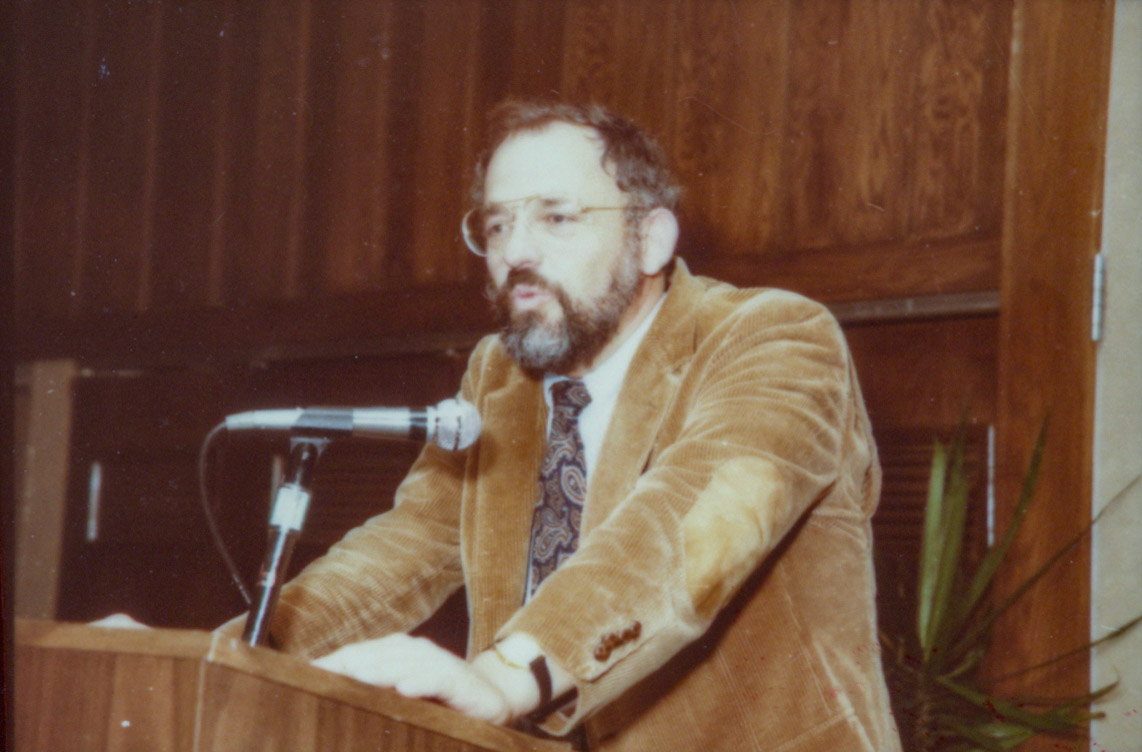
What began with a professor’s love for teaching evolved into a program known by every engineer in the world. Its origins began at The University of New Mexico in the late 1970s. That professor was Cleve Moler and his invention, MATLAB, is used in industries ranging from aerospace to medicine.
Moler passed away from Parkinson’s Disease in May, but his impact on former students, colleagues and The University persists decades after he taught on campus and helped The Department of Computer Science take root.
A mentor and friend
Jack Dongarra, a UNM alumnus (‘80) and Association for Computing Machinery A.M. Turing Award recipient, earned his Ph.D. in Applied Mathematics under Moler’s mentorship. The two first met at Argonne National Laboratory while Dongarra was an undergraduate student interning at the lab. Moler had come for a visit and Dongarra was tasked with introducing him to the Argonne computing systems, “which he of course had no problem grasping.” It was the start of a long friendship. The two were part of the team that developed LINPACK and EISPACK, Fortran software libraries for performing numerical linear algebra on supercomputers.

What is Numerical Linear Algebra?
-Ed Angel
One of the fundamental topics in linear algebra concerns sets of linear equations.
“Cleve was a wonderful guy who just had an instinct to help others succeed,” Dongarra said. “He was always eager to help and just had this enormous amount of energy to take things on.”
After Dongarra earned a master’s degree in computer science from Illinois Institute of Technology, Moler encouraged him to get his Ph.D. at UNM.
The University’s Department of Computer Science was still in its early days and didn’t yet offer doctoral degrees, but Moler told him they could put together something in the Math Department. Dongarra took mathematics courses on UNM’s campus and worked as a TA in Moler’s Linear Algebra course, later continuing his studies and dissertation work at Los Alamos National Lab, Stanford University and Argonne National Lab.
Because they’d known each other for a while, Dongarra and Moler didn’t have the typical professor-student relationship, but there was always mutual respect.
“As a mentor and advisor, he was very approachable, had a strong belief that computations should be done correctly, documented, and developed with assurances that software would work and have a high standard for correctness.”
Later on, the two would get into “loud discussions” about the specifics of software. Moler was always eager to debate their viewpoints.
“He was stubborn,” Dongarra laughed. “It would take a lot to get him to change his mind.”
Still, Moler’s primary motivation was designing software with its users in mind.
“He made numerical linear algebra approachable, intuitive and useful to a very broad community,” Dongarra said. “He was an inventor and he was eager to learn how his invention was being used and how it could be improved.”
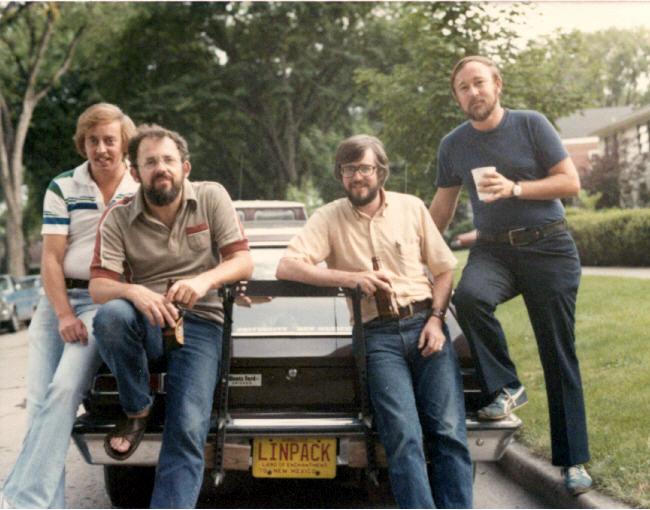
Chair of Computer Science
Moler joined UNM as an associate professor of mathematics in 1972, four years before the creation of UNM’s Department of Computing and Information Science (now Computer Science) in 1976. He became involved with the burgeoning program in the late 1970s when Ed Angel, a then-associate professor in the Department of Electrical Engineering and Computer Science (now Electrical and Computer Engineering), was seeking co-principal investigators for a project to bring a new computer to campus. When it arrived, the VAX 780 computer from the Digital Equipment Corporation was the most modern one at The University. It allowed for scientific computing and the connection of terminals, replacing simple punch cards. The team was able to connect the computer to the precursor of modern internet.
“We were able to get on the ARPANET early, which brought us into the realm of the big guys,” Angel said.
The VAX 780 went into the Farris Engineering Building, which put Angel and Moler in offices by the computer science faculty.
It was during this time that Moler began developing MATLAB to help his students access LINPACK and EISPACK without coding Fortran. All of Moler’s work was motivated by a love of math and showing others what it could be used for, Angel said.
“Cleve never set out to make any money,” Angel said. “If he had only been a professor at a small college, he would’ve been just the same.”
Proximity to the computer science faculty sparked collaborative innovation and in 1980, Moler was named professor and chair of the department. Decisions were made by consensus, and there was even a department band, The Modems, with backup singers known as The Discettes.
“I have never known a more congenial department than when Cleve was here,” Angel said.
Moler took his job as chair seriously, going so far as to spend days showing potential faculty around campus when they interviewed. One of those would-be faculty members was Paul Helman, who Moler hired after he completed his Ph.D. at the University of Michigan.
“He was not only the embodiment of what a chair and faculty member should be, but he embodied the spirit of New Mexico for me,” Helman, professor emeritus of computer science, said.
Decades later, Helman remembers Moler’s efforts to show him and his wife around the area, even helping them find a place they could live with their nine rescued animals.
Professionally, Moler worked hard to develop a first-class research program. When new faculty arrived, he helped guide them in how to spend time and connected them to work with the national labs. He also cared deeply about student learning and was just as eager for faculty to write a textbook as he was for them to publish results more traditionally, Helman said.
Moler resigned from UNM at the end of 1984 to accept a role as principal scientist and applications manager with Intel Development Organization. Around the same time, Moler and Jack Little formed MathWorks to commercialize and develop the software for greater consumer use.
Always Iterating

Friends and colleagues fondly remember Moler’s desire to continuously tinker with his creation. Around 1990, he teamed up with John Gilbert, who worked at Xerox, and Rob Schreiber, who worked at NASA, to integrate sparse matrices into MATLAB. They initially embarked on the research project hoping to write and publish papers on the subject, but were able to integrate their findings into the program. In doing so, MATLAB became more capable of supporting users looking to solve large, complex problems in science and engineering, like weather prediction.
Gilbert, whose father helped found the UNM Computer Science Program, first met Moler when he began teaching at UNM. Later, while living in California, Gilbert ran into Moler in a Trader Joe’s parking lot.
“Certainly on my life he had a larger impact than anyone else who was not in my immediate family,” Gilbert said.
The chance encounter at the grocery store eventually spun into the sparse matrices project, which Moler and Schrieber were working on. Scrieber did the programming systems, Gilbert provided a solver and sparse matrices expertise, and Moler knew exactly what he wanted it to look like so it would be easy to use. The three became close friends.
“It was the most fun project of my whole career,” Schreiber said. “We had almost instant agreement on everything and we were exceptionally good at what we were doing.”
Within six months it had been licensed by MathWorks and the major development shipped on the next release of MATLAB.
“Cleve was absolutely brilliant. He was not intimidated by conversations with physicists or computer engineers,” Gilbert said. “He could see what people needed to do to get from the problem they had to the actual computation they needed in order to solve the problem in linear algebra terms,” he said.
By the end of the 1980s, Moler was working full-time at the company he’d co-founded.
Making of MathWorks
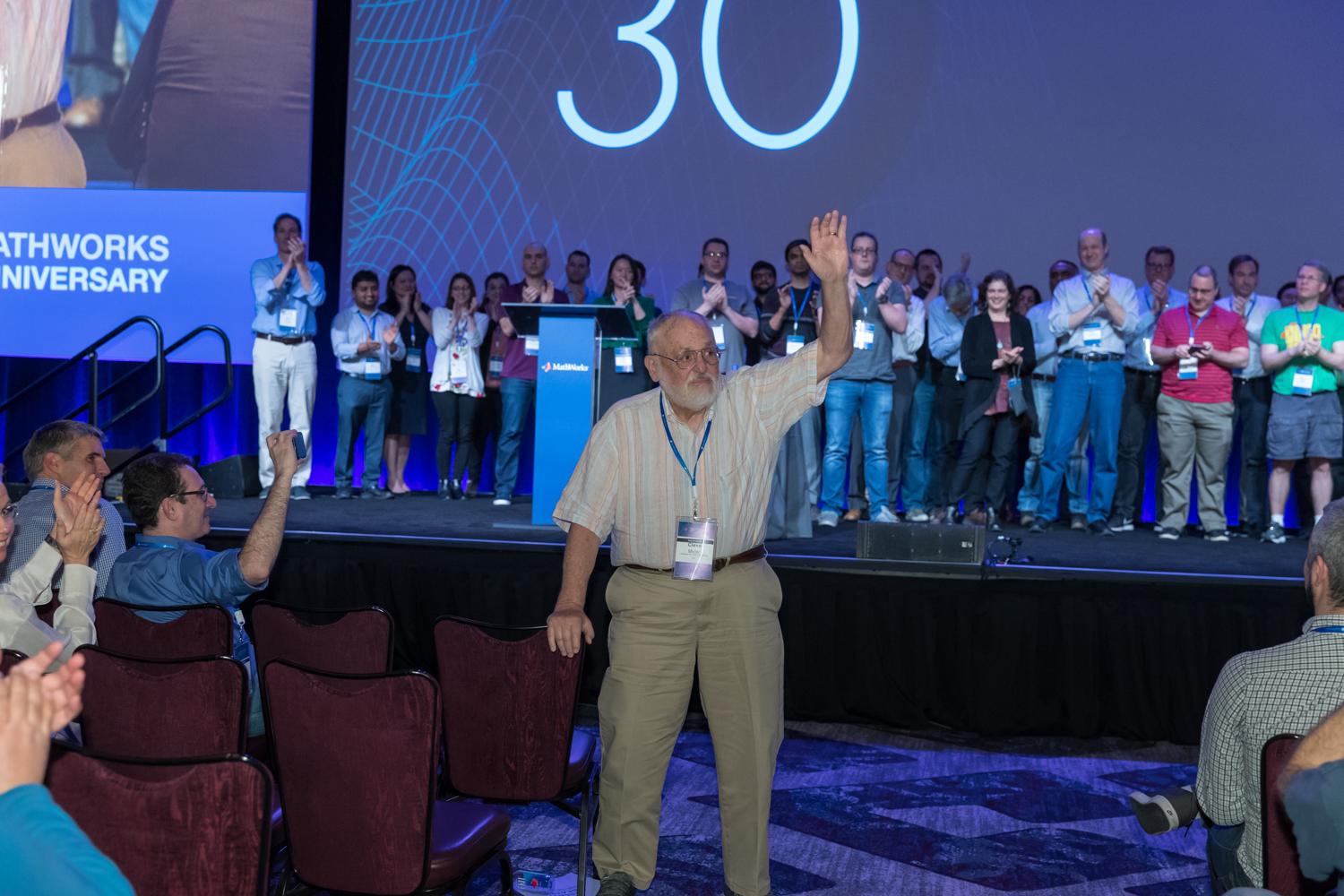
Today MathWorks employs more than 6500 people and has an estimated annual revenue of over $1.5 billion. For years, Moler held the title of chief mathematician, setting the mathematical vision for MATLAB, and wrote regular updates on Cleve’s Corner, his blog on the MathWorks website.
Penny Anderson, director of engineering at MathWorks, first met Moler during her job interview at the company in 1995. He would jokingly tell people they got into an argument during the conversation, but that’s not quite how Anderson remembers it.
“He delighted in having someone to exchange ideas with, push back on, and discuss numerical linear algebra with,” she said. “He was a great mentor and teacher interested in education and making mathematics comprehensible.”
Even after Moler retired, the company’s core values have remained the same.
“The number one thing for us is to get the answer right. We stake our reputation on that and it comes straight from Cleve,” Anderson said. “Cleve had a desire for robust algorithms, beautifully presented to as wide an audience as possible and we strive for that across the company.”
Decades after Moler developed the first version of MATLAB, his impact and support of students on the UNM campus persist.
In 2022, the company established the Cleve Moler and MathWorks Endowed Chair in Mathematical and Engineering Software in the UNM School of Engineering. The inaugural recipient of the title, Pavithra Prabhakar, was hired in fall 2025.
The chairship stands as a reminder of Moler’s tremendous efforts to support learning throughout his life and career.